Sitrep for Oct. 12-15, 2026 (as of 10 a.m. UTC+3)
Frontline Situation Update
In the Oleksandrivka direction, the Armed Forces of Ukraine continue their offensive. After the Russian Armed Forces command redeployed units of the 90th Tank Division from this direction to the Kostiantynivka direction and elements of the 41st Combined Arms Army to the Dobropillia direction, Russian defensive positions at the junction of the Donetsk and Dnipropetrovsk regions weakened. The AFU thus took advantage of the fact that Russian forces had made the Sloviansk–Kramatorsk, Dobropillia, and Kostiantynivka directions their priorities and launched counteroffensive operations in areas that were less of a priority for the RuAF.
At the same time, the position of the RuAF in the Dobropillia and Oleksandrivka directions deteriorated somewhat following a Ukrainian missile strike on command posts in Donetsk on Aug. 26. According to an investigation by Mediazona, at least 20 officers were killed, nine of whom served at the headquarters of the 41st Combined Arms Army. Mediazona also reported that another eight officers from the same army had been killed on Aug. 4, 2026. The loss of so many staff officers likely further complicated the army’s command and control.
According to French analyst Clément Molin, the AFU have advanced in the Oleksandrivka direction from the village of Komar toward the village of Fedorivka, which is already in the contested area. The village of Shevchenko may also have come under Ukrainian control, although this has not yet been confirmed. According to Molin’s infographic, the AFU are already attacking from Shevchenko toward the villages of Burlatske and Vilne Pole.
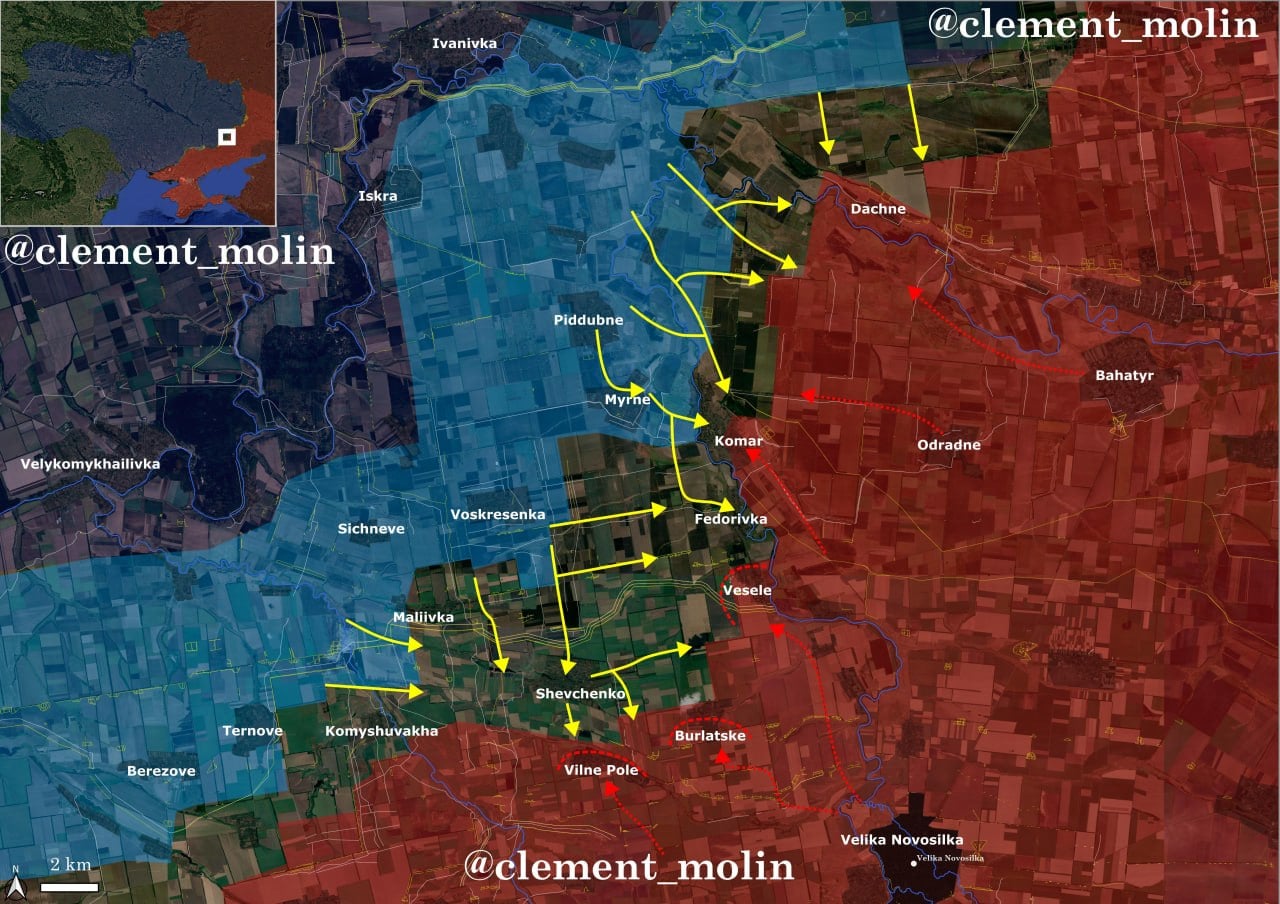
According to Ukrainian military observer Kostiantyn Mashovets, Ukrainian forces are gradually advancing from the village of Novopavlivka toward the villages of Dachne, Horikhove and Kotliarivka. The AFU have managed to liberate the villages of Zirka, Yalta, and Zaporizhzhia in the Donetsk region. They are therefore also attacking Dachne from the direction of Zaporizhzhia. As a result, Russian positions in the village of Filiia in the Dnipropetrovsk region risk being encircled once the AFU reach Dachne from both Novopavlivka and Zaporizhzhia. Mashovets also reported the liberation of Shevchenko and AFU advances toward Vilne Pole and Burlatske.
The pro-Russian Telegram channel Rybar has once again shown a situation on its map that is more favorable to the AFU than even DeepState does. It is worth noting that Rybar previously marked Ukrainian gains in the Shandryholove salient; it has now expanded the contested area in the Oleksandrivka direction to include Komar, Fedorivka, and Shevchenko.

In the Dobropillia direction, Russian forces are making gradual, albeit rather slow, advances. Fighting is ongoing in the vicinity of the villages of Zolotyi Kolodiaz, Vesele, and Hruzke. The Russian MoD announced the capture of the villages of Marivka and Novotroitske, northwest of Zolotyi Kolodiaz. Apparently, both settlements have indeed entered at least the contested zone, while Russian assault troops continue infiltrating farther into the area. Thus, the RuAF are advancing toward the town of Dobropillia.

In the Sloviansk–Kramatorsk direction, some reports indicate that Ukrainian forces are conducting successful counterattacks, pushing the RuAF back from the villages of Rai-Oleksandrivka and Kryva Luka. However, we have not yet seen any evidence of this. Instead, the situation appears to have stabilized, with Russian advances in this sector having largely stalled. The situation in the town of Mykolaivka remains precarious. Russian assault troops continue infiltrating the town, although doing so has become more difficult. Ukrainian forces have moved closer to the Siverskyi Donets River from the north and can engage Russian assault troops moving toward Mykolaivka from Kryva Luka.
In the Lyman direction, where the AFU have been clearing the Shandryholove salient, Ukrainian forces have summed up the results of the fourth "season" of Operation Vivaldi. According to reports, the AFU have liberated the villages of Zelena Dolyna, Kolodiazi, and Lypove. Although four "seasons" in total were announced, we suspect that not all Ukrainian gains have been publicly reported yet. Consequently, the 3rd Army Corps may continue announcing further advances, at least as far as the Zherebets River. The area is still marked on the DeepState map as being under RuAF control; however, the actual situation on the ground is likely to be more accurately characterized as a contested zone.

Ukrainian and Russian Strikes
According to the UNIAN Ukrainian news portal, Iryna Terekh of Fire Point said that Ukraine had used the FP-7 ballistic missile to strike Russian territory for the first time. However, we recently reported that on Oct. 1, Volodymyr Zelenskyy announced the first combat use of the FP-7 ballistic missile without specifying the territory where it had been used. The available information does not make it possible to determine whether Terekh was referring to the same strike as Zelenskyy or whether the president was talking about a strike on occupied territory.
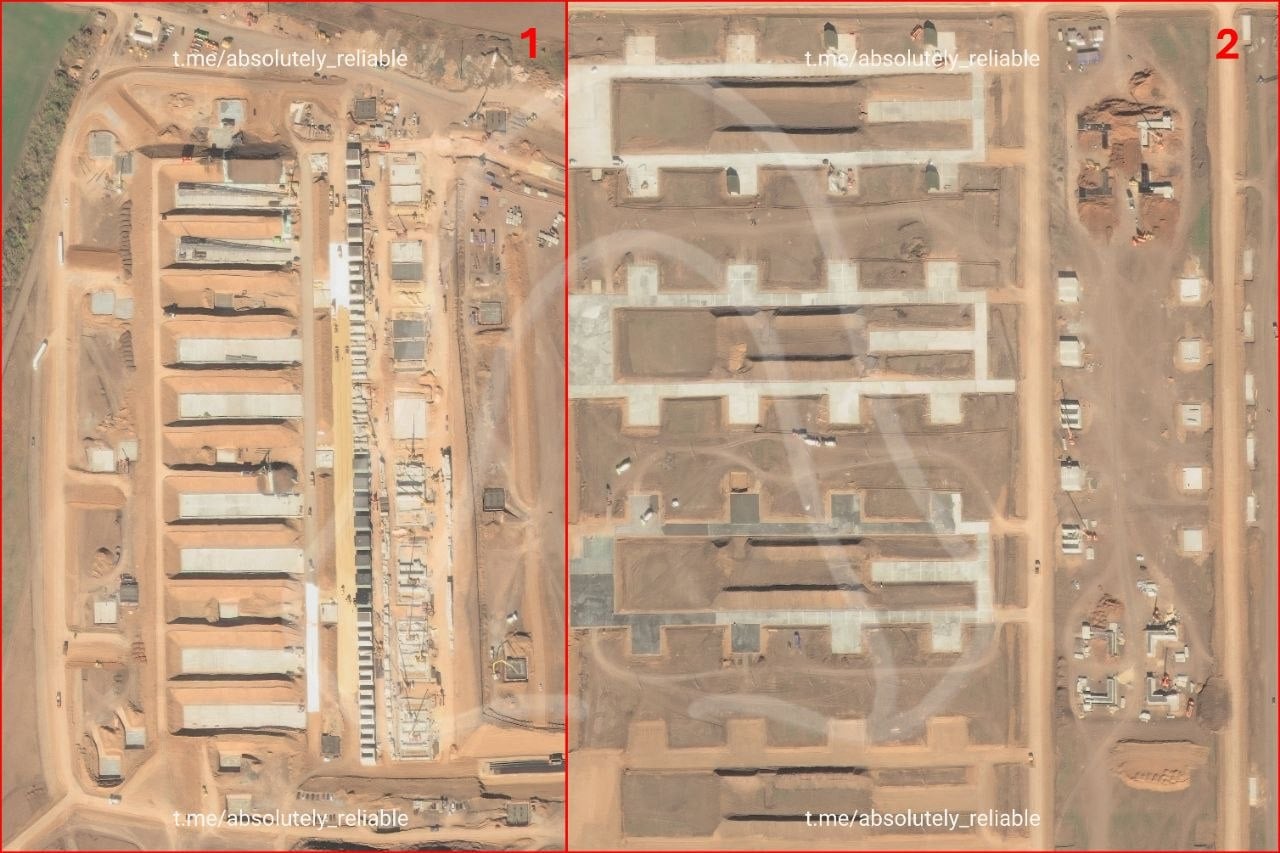
It has been reported that Russia has reportedly built a new drone launch site, dubbed Millerovo, in the Rostov region, apparently near Millerovo military airfield. Judging by satellite imagery, construction took about a month. The images show eight prepared sites for launchers intended to launch Geran-5 cruise missiles, as well as 32 32 launch preparation positions. This is another large-scale facility that would be extremely difficult to destroy with UAV strikes due to its size. However, missiles such as the Flamingo could be used against it, whereas air-dropped bombs would not have the range to reach it.

On Oct. 12, Russia struck a hotel in the city of Kharkiv with a Dan-T missile. Brazilian volunteer fighters serving in the AFU were staying there. The moment of impact was captured on video filmed by a Portuguese-speaking man. It is likely that their location was identified using similar videos, indicating that information security in this case was inadequate. OPSEC protocols must be observed particularly carefully when personnel are stationed in a frontline city.
An important consideration when striking legitimate military targets in densely built-up urban areas is whether the expected collateral damage would be excessive in relation to the anticipated military advantage. If it is, the strike would violate international humanitarian law and could constitute a war crime. According to our information, 23 people were injured in Kharkiv that day.
Trump unilaterally announced an energy ceasefire, while Ukraine and Russia knew nothing about it. Despite this, Zelenskyy supported the idea and did refrain from striking Russian oil refineries—we have not seen any such strikes in recent days. Meanwhile, Russian Deputy Prime Minister Alexander Novak stated that Ukrainian drones attacked two oil refineries on Oct. 14, violating the ceasefire, but local authorities and monitoring Telegram channels reported nothing about such strikes. We seriously doubt that local authorities managed to keep the strikes secret or that local residents failed to notice either an explosion or a fire.
Zelenskyy, in an interview with the Financial Times, announced the lifting of the temporary ban on strikes against Russian oil refineries. According to him, Kyiv had agreed to Washington's request to halt such attacks, but Russia continued launching strikes on Ukrainian energy infrastructure. At the same time, Ukraine faced disruptions in receiving US intelligence on Russian ballistic missile launches and restrictions affecting Starlink satellite internet service. Commenting on the latter, Zelenskyy stated that this was not a technical problem, but a political decision.
Indeed, on Oct. 12 and Oct. 13, Ukrainian sources reported a lack of warnings during launches of Russian ballistic missiles. On Oct. 13, Zelenskyy stated that partners had not warned Ukraine about five ballistic missiles that struck civilian infrastructure in Kyiv the previous evening. The president emphasized that intelligence on ballistic missile launches is critical for issuing timely public warnings and saving lives. At the same time, according to Politico, the American side attributed the lack of warnings about launches in the early hours of Oct. 13 to poor weather conditions, which prevented the relevant systems from detecting the missile launches. Meanwhile, Ukrainian Foreign Minister Andrii Sybiha confirmed that Ukraine continues to receive intelligence data from the US. In addition, Yurii Ihnat, Head of the Communications Department of the Air Force of the Armed Forces of Ukraine, reported that during a Russian attack in the early hours of Oct. 14, Ukraine's partners had not warned it about the first wave of ballistic missiles but had provided warnings about the next three waves. Thus, the available information does not support the conclusion that the US has completely stopped sharing intelligence with Ukraine.
The restrictions on intelligence sharing could theoretically have been introduced at the initiative of individual US military officials, without a direct order from Trump, as was the case with the 2025 suspension of arms deliveries to Ukraine. However, there is no evidence to support this theory.
In Bulgaria, two unidentified individuals set fire to 11 of the 17 antennas at a Starlink satellite communications ground station near Sofia. The incident was reported by Ivaylo Mirchev, a lawmaker from the Yes, Bulgaria! party. It is unclear when the arson took place. A similar attack occurred in Poland in late September. It remains unclear whether the damage to the Bulgarian station is related to disruptions in satellite communications in Ukraine.
In the early hours of Oct. 14, Ukrainian forces encountered Starlink satellite communication restrictions when terminals were moving at high speeds. According to Serhii Sternenko, connectivity initially began failing at speeds exceeding 160 km/h [100 mph], with the threshold later dropping to 60–70 km/h [37–43 mph]. As a result, several combat operations were disrupted. The AFU’s 7th Air Assault Corps reported that some operations had to be canceled due to the restrictions, while the use of high-speed drones for middle-strike attacks became nearly impossible. According to military personnel, even at speeds of 110–120 km/h [68–75 mph], the drones could lose connectivity for 10–20 seconds, during which operators lost control of the aircraft, although they continued flying. Ukrainian military expert Serhii "Flash" Beskrestnov confirmed that the restrictions primarily affected Starshield, the military version of Starlink, which had previously supported communications with terminals moving at high speeds. According to Beskrestnov, Starshield’s speed limit was set at 100 mph [approximately 160 km/h], and the Ukrainian Defense Forces received no prior notice of the restrictions. Beskrestnov attributed the restrictions to the political situation surrounding Ukraine.
Spaceflight popularizer Georgy Trishkin pointed out a key difference between the civilian Starlink service and the military Starshield. Speed restrictions for terminals in motion already existed in the standard Starlink service, while the new restrictions specifically affected Starshield. Fixed terminals continue to operate. Trishkin also noted that neither Starlink nor Starshield had ever officially supported the use of terminals in Russia. According to Trishkin, the European satellite communications system OneWeb is used to control naval drones during attacks on Russian targets.
Elon Musk said that speed and operational restrictions on Starshield are set by the Pentagon and ultimately by the US president, not by SpaceX leadership. Allegations that Musk personally ordered restrictions on connectivity for Ukrainian forces therefore remain unconfirmed. On the evening of Oct. 14, former Ukraine's Defense Minister Mykhailo Fedorov said that the Starlink speed restrictions affecting terminals traveling at up to 160 km/h had been lifted. On Oct. 15, Serhii Sternenko wrote that Starshield service had been restored, as was also reported by the media.
Following strikes on Yandex data centers, claims spread on social media that Russian propaganda bot activity had dropped sharply, including bots supporting Donald Trump and Germany's Alternative for Germany (AfD) party. However, as Leonid Volkov explained, the claims were based on a misreading of a Cloudflare graph showing a drop in traffic from Yandex networks, including the activity of search engine bots that index websites. These data have nothing to do with propaganda bots on social media. Moreover, it is not advantageous for botnet operators to host large numbers of accounts in a single data center, as this makes them easier for anti-fraud systems to detect and block. A botnet control system could theoretically have been located there, but there is no evidence to support this.
In the early hours of Oct. 14, Ukrainian drones attacked a Sberbank data center in Balakovo, in the Saratov region. The building's entrance was reportedly damaged, while the extent of other damage remains unknown. Following the strikes on Yandex data centers, such an attack was entirely predictable. To our knowledge, it is virtually impossible to destroy all information about a bank's customers by striking individual data centers. Regional bank branches likely maintain their own data storage systems containing copies of local customers' records, while the most critical information is backed up at multiple geographically separate locations. Therefore, even if individual data centers are destroyed, the data can most likely be recovered. However, such strikes can disrupt banking services, cause payment processing failures, and temporarily restrict access to account information. Nevertheless, it is unlikely that customer data could be permanently destroyed in this way.

Russia is intensifying its strikes on Ukrainian energy infrastructure, using ballistic missiles and Zircon missiles, among other weapons, to target combined heat and power plants. A winter campaign of strikes is gradually unfolding, with The New York Times and Radio Free Europe/Radio Liberty having previously reported on plans for such a campaign. Its objective is to deprive Kyiv and the Kyiv region, as well as border and frontline regions, of electricity, heating, and water supplies.
The Russian MoD reported strikes in the early hours of Oct. 14 against combined heat and power plants and other energy facilities in Kyiv as well as the Kyiv and Kharkiv regions. Meanwhile, Russian presidential spokesman Dmitry Peskov stated that the energy ceasefire proposed by Trump had not been specified in detail, meaning that Russia could not be said to have violated it. Thus, the Russian authorities are showing no intention whatsoever of halting their strikes on Ukrainian energy infrastructure.

It remains unclear how this will affect relations between the US and Ukraine. We cannot rule out that, amid the upcoming congressional midterm elections, Trump may blame Zelenskyy for his own political setbacks, potentially leading to further decisions by the US administration concerning Ukraine.
We need your support to continue our efforts. Please consider making a monthly donation to CIT through our fundraising page or Patreon.