Sitrep for Oct. 15-19, 2026 (as of 10 a.m. UTC+3)
Frontline Situation Update
On Oct. 16, the Russian Ministry of Defense released a report on Putin’s visit to an auxiliary headquarters of the joint military grouping of the Russian Armed Forces, where he was briefed on the RuAF’s "successes" along the frontline. In particular, it was announced that the town of Dobropillia in the Donetsk region had been "liberated." Although fighting for the town began back in the summer, when assault troops began actively infiltrating it from the villages of Hannivka and Dobropillia, as well as Vodianske, Russian forces have yet to capture even a single part of the town. Nevertheless, as proof of its capture, the Russian MoD showed an AI-generated video—even though the military could clearly have sent assault troops into the town to stage a flag-planting photo op. Perhaps the grouping’s command had been given a strict deadline, and no recent footage was available.
The report also claimed that Russian forces had captured the village of Oleksiievo-Druzhkivka, north of the town of Kostiantynivka, which according to official Russian reports had already been captured in July. The situation there is similar to that in Dobropillia: although fighting for Oleksiievo-Druzhkivka has been underway for quite some time, Russian forces have yet to capture the village. This village is an important target for the RuAF. Since Russian forces have been unable to capture Kostiantynivka through infiltration, they are trying to outflank it from both sides and cut Ukrainian supply routes. This would make it much easier to capture Kostiantynivka.
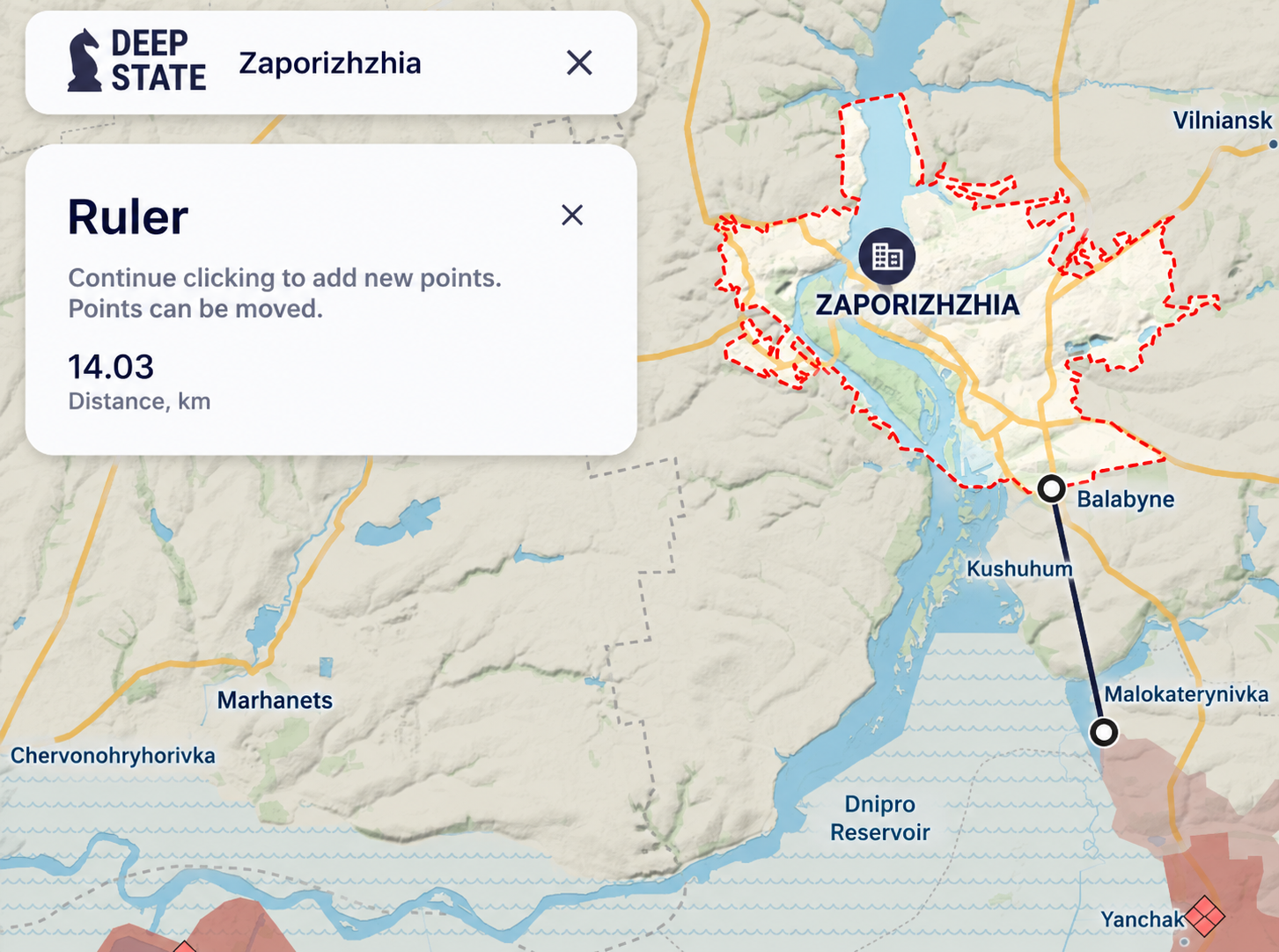
As General Valery Gerasimov, Chief of the General Staff of the RuAF, told Putin, Russian troops are 5 km away from the city of Zaporizhzhia. Even pro-Russian milbloggers found this claim absurd. In our assessment, in the western part of the Zaporizhzhia region, on the Stepnohirsk axis, the frontline largely coincides with the DeepState map. The distance from the outskirts of Malokaterynivka, where the contested area ends, to the outskirts of Zaporizhzhia is approximately 14 km. The advance toward Zaporizhzhia is complicated by the need to cross the Konka River. Assault troops may already be able to infiltrate Malokaterynivka itself. However, the Russian MoD has already claimed to have captured this village, a claim that Ukrainian forces were quick to refute.
Among other things, Putin emphasized what he described as the high rate of the RuAF’s advance, claiming that Russian forces had captured 6,500 km² since the beginning of the year. The claim surprised even audiences generally sympathetic to the Russian authorities and brought to mind reports on Russia’s 2015-2017 military operation in Syria, which suggested that Russia had liberated an area from ISIS nearly three times the size of Syria itself.
Meanwhile, according to Rochan Consulting’s estimates, Russian forces had captured approximately 1,500 km² since the beginning of 2026 as of the middle of the previous week. During the same period last year—from January to approximately early October 2025—Russia captured 3,251 km², meaning that the rate of territorial gains this year has fallen by half. Even the pro-Russian project Slivochnyi Kapriz [Creamy Caprice], which typically marks territory as Russian-controlled at the first sign of a Russian military presence, calculated that the RuAF had lost 72 km² during the first half of October. Unless the statistics are adjusted at the end of the month to include territory supposedly captured in the border area of the Kharkiv region, where Russian forces claimed to have cleared an encircled Ukrainian grouping, October will become the first month in which the RuAF records a net territorial loss, according to the outlet.
Notably, the situation along the frontline has taken a back seat amid discussions of possible negotiations and a ceasefire between Ukraine and Russia. We therefore doubt that reports of Russian territorial losses will have any significant impact on these discussions.
Ukrainian and Russian Strikes
Putin acknowledged that the Russian authorities had failed to anticipate Ukraine’s retaliatory actions against Wildberries and Ozon. This follows from his response to a question from Tatyana Kim regarding strikes on warehouses belonging to Russian online marketplaces. According to Putin, Ukraine "keeps taking certain actions which, frankly speaking, we [the Russian authorities] probably should have anticipated, but we thought they [the AFU] wouldn’t think of doing something like that—and they did."
We have long suspected that Ukraine receives small batches of interceptor missiles for Patriot surface-to-air missile systems at around the beginning of each month and uses them up by the middle of the month. Chris Miller of the Financial Times has also written about this. Therefore, CNN's report that Ukraine had run out of these missiles likely referred to the depletion of its current stockpile before the next delivery, rather than a complete halt to deliveries.
Recently, Volodymyr Zelenskyy clarified that the United States supplies Ukraine with only 12 Patriot missiles per month—roughly one-quarter of the amount supplied under the Biden administration. Ukraine now purchases them through the PURL mechanism, whereas previously it received them as US military aid. According to Zelenskyy, the weapons have already been paid for, but Washington has authorized the delivery of only a portion of them.
Twelve missiles per month is an extremely small number. If two interceptor missiles are launched at each ballistic target to increase the probability of interception, this allocation would be sufficient for just six targets—often the number of ballistic missiles Russia uses in a single attack. Moreover, the limited stockpile must be distributed among several Patriot batteries, which cannot be rapidly redeployed between Kyiv, Dnipro, Zaporizhzhia, Lviv, and other cities. A significant share of the missiles is likely reserved for the defense of the capital, while systems in other regions may sit idle for lack of munitions.
Donald Trump once again criticized Zelenskyy and accused the Biden administration of depleting US weapons stockpiles. According to Trump, the Democrats transferred large quantities of Patriot systems, Tomahawk missiles, and other munitions to Ukraine free of charge, forcing the United States to accelerate efforts to replenish its arsenals. In reality, Ukraine has never received Tomahawk missiles, either under Biden or under Trump. Kyiv requested such deliveries from both administrations, but none have materialized. Trump may have misspoken while listing various types of weapons whose stockpiles he considers insufficient.
In the early hours of Oct. 17, Russia launched one of its largest strikes on Ukraine’s energy infrastructure. Several regions experienced widespread disruptions to electricity and water supplies. In Vinnytsia, residents lined up at public water pumps after power outages knocked out the city's water supply pumps. As in other such cases, these strikes primarily affect the civilian population. As usual, the Russian MoD reported strikes on electrical substations "that ensure the operation of military-industrial enterprises." However, this explanation does not account for why large-scale attacks on energy infrastructure intensify as cold weather approaches and continue throughout the winter, rather than being distributed more evenly throughout the year.

In the early hours of Oct. 18, Ukraine carried out one of its largest drone raids on European Russia. According to a statement by Moscow Mayor Sergey Sobyanin, 512 UAVs were heading toward the capital on Oct. 18: 127 were allegedly shot down on approach to Moscow, while the rest were intercepted farther away. These figures cannot be independently verified.
Saint Petersburg and the Leningrad region came under particularly intense attack. One person was killed, and at least 10 others were injured. The sites hit included a VK data center, the Vostochnaya substation, the St. Petersburg Oil Terminal, the Ruchyi oil depot, and an Ozon warehouse in the Kolpinsky district. The strike on the oil terminal is particularly significant amid Russia’s shrinking options for exporting oil through the Black Sea: a substantial share of oil and petroleum product shipments is being rerouted through the Gulf of Finland and the Baltic Sea. The extent of the damage to the terminal remains unknown.
One of the drones also struck a cable-stayed bridge over the Korabelny Fairway. However, it is too early to say with confidence that the bridge was the intended target. It may have been a deliberate strike intended to send a message, but the drone could also have collided with a tall obstacle while heading toward another target. Satellite images of the aftermath later emerged, showing signs of fires and destroyed storage tanks.


Drone attacks over the past 10 days have led to numerous flight cancellations and delays at Moscow airports. Such consequences were foreseeable: as early as Sept. 1, Zelenskyy warned airlines about the possible closure of Russian airspace as part of Operation M&Ms. Airports could therefore have prepared their infrastructure in advance and arranged for water, food, and temporary accommodation for passengers. However, rather than daily launches of up to 1,000 UAVs, the Ukrainian operation now appears to involve periodic waves of intensive drone raids lasting several days, causing major disruptions at airports.
British Defence Intelligence has released a detailed satellite image showing the aftermath of an Oct. 4 Ukrainian strike on the Khanskaya air base near Maykop in Adygea [Russia's constituent republic]. According to the intelligence assessment, the attack destroyed a Sukhoi Su-34 fighter-bomber, a Sukhoi Su-35 fighter, two ammunition depots, and another building, while also damaging the runway. The destruction of both combat aircraft was previously claimed by the Security Service of Ukraine (SBU).

An even more successful Ukrainian missile strike targeted the Borisoglebsk air base in the Voronezh region in the early hours of Oct. 15. According to the Ukrainian Navy, the attack was carried out using Neptune subsonic cruise missiles—likely the extended-range Neptune-D variant. Ukrainian authorities claimed four Su-34 fighter-bombers were destroyed and two others damaged, with satellite imagery confirming the destruction of four aircraft.

The destruction of four Su-34s represents roughly one-third to one-half of Russia's annual production of these aircraft. Combined with the Su-34 destroyed at Khanskaya, Russian forces lost five of the frontline fighter-bombers within a two-week span. The Su-34 serves as Moscow's primary platform for launching guided glide bombs—FAB bombs equipped with Universal Gliding and Correction Modules (UMPK)—which Russian forces regularly use to strike Ukrainian frontline cities, including Kharkiv, Zaporizhzhia, Sloviansk, Kramatorsk, and Kherson.
Russia maintains a substantial inventory of Su-34 fighter-bombers, meaning a rapid and significant reduction in the number of airstrikes is unlikely. However, such strikes could force Russian commanders to relocate aircraft to more distant air bases. This would increase flight times and allow Ukrainian forces to detect Russian aircraft activity earlier and warn the population of potential air attacks.
The accuracy of such strikes depends heavily on timely, high-quality intelligence, meaning a potential halt to US intelligence sharing could reduce the effectiveness of Ukrainian strikes. The impact would be less significant for fixed targets such as air bases, which are clearly visible in commercial and European satellite imagery. Restrictions on intelligence sharing could have a much greater impact on locating mobile targets, such as Iskander missile launchers, as well as temporary command posts.
Ukrainian forces have begun tracking Russian Mil Mi-28 attack helicopters in the Belgorod region. Footage has been published of two separate FPV drone attacks targeting the helicopters’ main rotor blades. The attack sites are about 4 km apart, suggesting that the helicopters may regularly fly the same route, where Ukrainian drones may now be positioned to intercept them. According to available information, VB140 Flamingo interceptor drones were used in these attacks. Both videos end as the UAVs approach the rotor blades, so the outcome of the attacks remains unknown.
A video shows a new AFU tactic involving a kind of "drone extender." The heavy Ukrainian Vampire UAV, also known as Baba Yaga, is itself controlled via fiber-optic cable and carries another fiber-optic FPV drone. The Vampire carries the FPV drone deep into the Russian rear and lands, after which the FPV drone takes off and continues toward its target, maintaining communication with its operator through the carrier drone. The claimed range of the second stage is up to 60 km. After the target is hit, the Vampire could, in principle, detach the used fiber-optic cable and return for reuse.
The main topic of discussion in recent days has been the possible restrictions on the provision of US intelligence to Ukraine and on the operation of Starlink and Starshield. However, we cannot reliably establish whether these restrictions were imposed, by whom, or whether they remain in effect. Statements by Zelenskyy, Trump, Rubio, US and Ukrainian officials, as well as reports citing anonymous sources, contradict one another: some claim that intelligence sharing was suspended, while others say it continued; some report that access has been restored, while others describe ongoing problems. The situation surrounding Starlink and Starshield is similarly unclear.
It is not clear whether senior officials understand the difference between Starlink and its military counterpart, Starshield. Moreover, they may be genuinely mistaken or knowingly making false statements.
Citing several sources, The Kyiv Independent correspondent Jimmy Rushton reported new "technical issues" affecting Ukrainian Starshield terminals, which resulted in the loss of multiple UAVs. His sources claimed that SpaceX, rather than the Pentagon, was deliberately imposing the restrictions to disrupt Ukrainian drone operations. However, Ukraine uses Starshield under a contract with the Pentagon, which suggests that the company should not have imposed such restrictions independently without authorization from US authorities.
No less puzzling is a report by Axios, according to which Starlink and Starshield terminals previously operated on drones traveling at speeds of up to 400 km/h, but are now limited to 161 km/h. For regular Starlink terminals, a speed limit of approximately 160 km/h, as far as we were able to verify, applies worldwide, so it is unclear how they could previously have operated at speeds of 400 km/h. It is possible that the Ukrainian sources were referring only to Starshield, but the article groups the two systems together.
US Secretary of State Marco Rubio, responding to a question about the restrictions, said that Ukraine does not currently have Starshield and has never received it, and that talks on providing access are still ongoing. This directly contradicts previously published information: back in 2024, Bloomberg reported that the Pentagon had signed a contract with SpaceX to provide Ukraine with access to approximately 3,000 Starshield terminals. Thus, Rubio either got the details mixed up or provided inaccurate information.

The conflicting accounts have prompted nine US senators from both parties to ask the Pentagon’s inspector general to investigate whether the US had restricted the operation of Starlink and Starshield and suspended intelligence sharing with Ukraine. Judging by the senators’ letter, even members of Congress do not have a clear understanding of the situation.
There have been reports that intelligence sharing has resumed and that Starlink services, and possibly Starshield services, are gradually being restored. However, according to Yurii Ihnat, head of the Communications Department of the Air Force of the Armed Forces of Ukraine, no warning was received from international partners during the first wave of the attack in the early hours of Oct. 19. At the same time, Trump has not typically reversed other decisions that drew serious political criticism so quickly, which means that deliberate restrictions, technical failures, or a combination of these factors cannot be ruled out for now.
Conscription, Mobilization and Contract Military Service
Less than two weeks remain until the end of October, and the elections are long over, yet there are still no signs of preparations for a new wave of mobilization.
In Saint Petersburg, the regional sign-up bonus for enlisting in the Russian military has been cut almost fourfold—from 3.5 million rubles [$41,800] to 1 million rubles [$12,000]. In our view, this may indicate that the city has already fulfilled its annual target for recruiting contract soldiers, so the authorities no longer see the point in maintaining such a high payout.
Payouts will likely be reduced toward the end of the year in other regions that have fulfilled their targets as well. At the beginning of 2027, they may be raised again after new recruitment targets are approved. The Russian army still needs additional manpower, but regional authorities are primarily focused on meeting their recruitment targets at the lowest possible cost.
We need your support to continue our efforts. Please consider making a monthly donation to CIT through our fundraising page or Patreon.