Sitrep for Nov. 5-9, 2026 (as of 10 a.m. UTC+3)
Frontline Situation Update
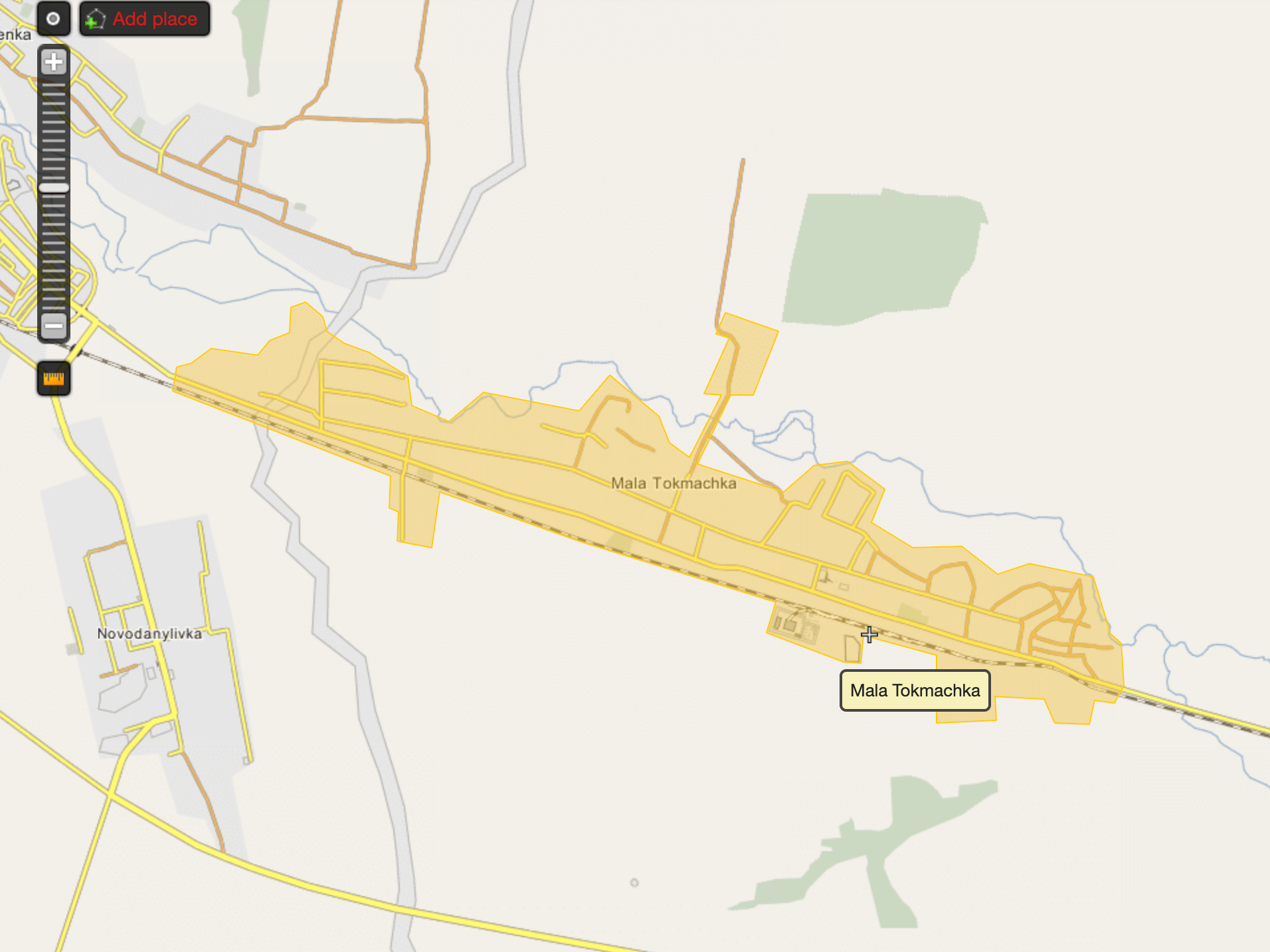
Fighting in the village of Mala Tokmachka in the Orikhiv direction continues to be discussed. A video has emerged showing Russian soldiers striking Ukrainian positions on the grounds of the Orikhiv Penal Colony in the eastern part of the village. An assault on positions there was previously reported in mid-October. These strikes indicate that the complete capture of the village remains far off: it remains partly in the contested area and partly under the control of the Armed Forces of Ukraine. Notably, Ukrainian military observer Kostiantyn Mashovets mentioned these positions in his updates on Sept. 26 and Nov. 5. However, according to his reports, it was a small Russian assault group that had taken shelter on the grounds of the penal colony.
New footage has also emerged showing Russian assault troops in the western part of the town of Dobropillia in the Donetsk region. For now, we classify the entire town as a contested area. It is premature to speak of its capture, as Ukrainian positions have been documented in the eastern part of the town. In addition, Russian drone operators struck a Ukrainian position in a tree line east of Dobropillia, near the village of Novyi Donbas. Having failed to capture the town through frontal assaults, Russian forces are now trying to outflank it, while continuing to infiltrate the town and gradually build up their presence there.
Footage has emerged from the Zaporizhzhia direction purportedly showing drone operators from the Group of Troops "East" striking Ukrainian troops. However, as researcher Moklasen noted, the poses of the dead and the behavior of wounded soldiers and those fleeing from drones appear unusual. The bodies in the footage are clean and undamaged, with no visible traces of blood. The soldiers fleeing the drones make no attempt to return fire, while the drones strike the ground between them rather than hitting them from behind. In addition, no footage of UAV explosions filmed by reconnaissance drones has been released, while the FPV drone footage, as usual, cuts off just before impact.
After examining such footage, the researcher developed a hypothesis that they are actually staged, with Russian soldiers dressed as Ukrainian assault troops playing the part of the targets. We think this may indeed be the case, as the footage looks rather unconvincing. It is also interesting that this unit chose to produce fake footage itself rather than generate it using neural networks.
As we have previously reported, as Ukraine's middle-strike campaign intensified, Russian forces began deploying mobile fire teams to escort various vehicles, including fuel tankers, military trucks, and other transport, as a defensive measure. These mobile fire teams, in turn, became priority targets for Ukrainian drones. The next step taken by Russian forces was to deploy decoy mobile fire teams along highways. For this purpose, they use vehicles fitted with mannequins wearing helmets and carrying mock machine guns.
The concept of deploying drones on power lines for persistent area surveillance has also evolved. Ukrainian forces have now equipped UAVs—not conventional "ambush" drones, but rather "flying CCTV cameras" without warheads—with lightweight nets designed to secure them to the upper, thinner branches of trees. These drones are fitted with higher-capacity batteries than usual to extend their operational endurance. Presumably, when the battery charge runs low, the UAVs return to their operators to have their batteries replaced. According to reports, these UAVs are equipped with digital communications modules whose signals the RuAF often cannot intercept, as the RuAF generally rely on analog receivers. Drone detectors, meanwhile, are frequently configured to monitor different frequency bands, while visual searches for these "perched drones" typically focus on roadsides or lower tree branches.
Western Assistance
One of the most widely discussed issues in recent days has been the proposed allocation of $15 billion in US military assistance to Ukraine. According to the Financial Times, congressional Democrats plan to secure approval of this aid package during the current session of Congress, i.e., before December. To achieve this, they will seek to incorporate the military assistance for Ukraine into the US defense budget, which must be passed by the end of the year. It is difficult to predict whether they will succeed, particularly given that Democrats will not assume majority control until January. Once in control, they may even attempt to compel the executive branch to provide military or humanitarian assistance to Ukraine. For example, in 2024, Congress passed legislation requiring the executive branch to expedite the transfer of long-range ATACMS tactical ballistic missiles to Ukraine. However, these plans could be derailed by Trump, who appears intent on playing the role of "Mr. Veto." He could block the allocation of military assistance on the grounds that Pentagon stockpiles are being depleted. Such actions could negatively affect Republican Party approval ratings ahead of the next elections. However, Trump appears to have little concern for his party's electoral prospects: he cannot seek re-election, and he is shielded from criminal prosecution for actions taken in his official capacity as president. Consequently, Trump may well choose to act in defiance of political and institutional considerations. One example is his appointment of far-right ideologue Stephen Miller as White House Chief of Staff, the architect of the administration's highly unpopular immigration policy, which contributed to the Republicans' electoral defeat. That policy has been marked by ICE overreach and other controversial enforcement practices.

Ukrainian and Russian Strikes
Clearing the rubble has continued for a week after a Russian strike on a former underground school in the village of Komyshuvakha, in the Zaporizhzhia region. On Nov. 2, the first strike hit a gym and administrative offices. When police officers and first responders arrived, they descended into the shelter with civilians who had come for humanitarian aid. In a follow-up strike on the shelter, a three-ton air-dropped bomb collapsed the ceilings of the underground rooms. As of Nov. 9, the death toll had reached 55. Constant Russian strikes on the State Emergency Service of Ukraine have hampered efforts to clear the rubble. On Nov. 8 alone, three such strikes injured two first responders.

Recently, the Russian Aerospace Forces struck the village of Zarichne near Komyshuvakha with heavy air-dropped bombs. Videos of the bombing were published on Nov. 6. The Russian Ministry of Defense claims that Zarichne is an AFU deployment site and that Russian forces used a FAB-3000 bomb against it. The pro-Russian channel Iznanka, however, said that two FAB-1500 bombs struck Zarichne. Russian bombers continue to destroy what may be enemy deployment sites in this area.
In the early hours of Nov. 7, Russian forces carried out a large-scale missile attack on Ukraine, launching 36 ballistic missiles — the same number as in the entire week before last. The shortage of interceptor missiles remains critical — Ukraine managed to intercept only four of the 36. In the early hours of Nov. 3, Russian forces carried out another massive missile strike, launching 59 cruise missiles and three ballistic missiles. The main targets were energy facilities, mostly in the capital region. Last week, the RuAF used a total of 115 missiles of various types and more than 3,000 strike drones against Ukraine—1,000 more drones than two weeks earlier. It is worth noting that, in bad weather, Russia uses more piston-engine drones.
On Nov. 7, the RuAF again struck the Northern Bridge over the Dnipro River in Kyiv, with what appeared to be a ballistic missile. Russia's MoD, as before, said the bridge is used for military logistics, but so far these strikes have done little more than disrupt traffic for Kyiv residents.
At the same time, the RuAF continued striking Ukraine’s power grid. Volodymyr Zelenskyy reported damage to substations connecting the Rivne and Khmelnytskyi nuclear power plants to Kyiv and Ukraine’s central regions, as well as to energy facilities in Vinnytsia, Zhytomyr, Rivne, Kharkiv, and Dnipropetrovsk regions.
As explained by Ekonomichna Pravda, Kyiv consumes significantly more electricity than it can generate itself. No. 5, No. 6 and the Darnytsia combined heat and power plants, stopped generating electricity following the strikes. As a result, the capital is particularly dependent on the "Kyiv energy ring"—a network of high-voltage transmission lines and substations that delivers electricity from other regions, including from the Rivne and Khmelnytskyi nuclear power plants. To cause major disruptions, Russian forces would need to disable only a few key nodes. The system’s configuration is not classified information.

According to sources cited by the publication, under a relatively favorable scenario, power outages in Kyiv could last 8–10 hours a day. If Russian forces launch massive strikes during severe frosts, outages could last as long as 20 hours a day. Thus, the main threat to the power grid this coming winter is the combination of three factors: low temperatures, high electricity demand, and further destruction of the grid.
The Status-6 researcher noted a possible shift in Ukraine’s tactics for striking Russian oil refineries. Whereas previous attacks often involved isolated hits on primary processing units, Ukrainian forces are now, in his assessment, seeking to hit more complex secondary processing equipment, repeatedly attacking the same facilities and conducting raids in multiple waves. Footage of recent attacks does indeed show multiple fire hotspots across refinery sites. However, videos alone cannot establish exactly which units were damaged or whether this damage will disrupt production.
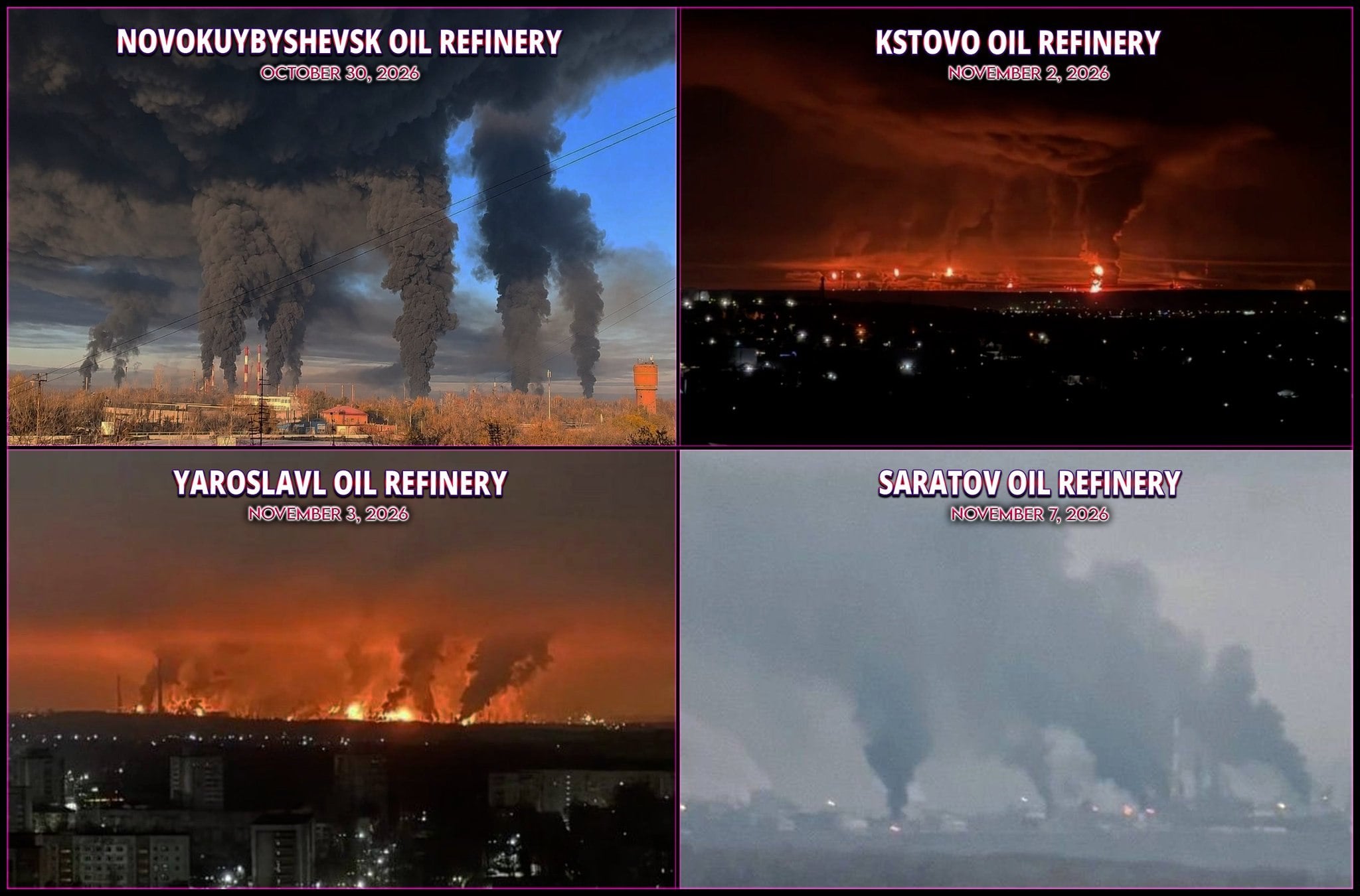
A similar pattern was observed after a UAV attack on the Saratov oil refinery in the early hours of Nov. 7. Videos released after the attack showed several fires on the facility’s grounds. The Astra Telegram channel geolocated the filming location and identified the target, but the full extent of the damage remains unknown.
The Ukrainian OSINT project Oko Gora has calculated the number of publicly confirmed successful strikes carried out using Ukrainian long-range missiles: 30 strikes with R-360 Neptune cruise missiles over 22 months, 13 with Flamingo missiles over 16 months, and 14 with Storm Shadow missiles over 22 months. These figures show that the Neptune missile is being used significantly more frequently than the widely publicized Flamingo, particularly in recent months. However, open sources provide no way to determine the actual production volumes and stockpiles of these missiles, or the scale of future Storm Shadow deliveries. It is therefore unclear how long Ukraine will be able to sustain its current strike rate.

In the early hours of Nov. 7, Neptune missiles struck the Proton-Electrotex plant in Oryol, triggering a fire at the facility. According to the AFU General Staff, the plant manufactures switch-inverter units for the 9K720 Iskander mobile short-range ballistic missile system and modules for S-71K Kover cruise missiles. The strike may therefore have been intended to create a shortage of specific components used in Russian missile production. However, its effectiveness can only be assessed once satellite imagery becomes available.
Conscription, contract service, mobilization
The approach of the end of the year can also be seen in changes to regional enlistment bonuses for contract soldiers. In Chuvashia, from Nov. 1 to Dec. 31, UAV operators, military doctors, and mid-level medical personnel have been offered a bonus of 3.1 million rubles [$37,800] from the republic's budget for signing a military contract, in addition to 400,000 rubles [$4,880] from the federal budget. For other contract soldiers, the regional bonus stands at 400,000 rubles [$4,880]. The limited validity period of the increased bonus may indicate an attempt to urgently recruit the most sought-after specialists and improve the annual recruitment figures.
Even statutory military service does not guarantee that a serviceman will not end up at war. Mediazona [independent Russian media outlet] has identified 350 Russian conscripts killed since the start of the full-scale invasion. The first significant peak came in 2022, when conscripts were sent to Ukraine, including by being made to sign contracts. The heaviest losses were recorded during the AFU operation in the Kursk region: at least 60 conscripts were killed in August 2024 alone. Russian authorities continue to use conscripts to guard border areas, where they are exposed to shelling and ground attacks.

Aleksandr Korolkov's case is illustrative. He was called up during the regular biannual conscription campaign in 2024. During his service, he attempted suicide. Afterward, he was diagnosed with a mixed personality disorder and assigned a service fitness category "V" (partially fit for military service). According to the case materials, this classification should have precluded him from signing a contract. Nevertheless, five days after being discharged from a psychiatric hospital, Korolkov became a contract soldier. His mother claims that the command pressured her son and that she was never shown the document.
In January 2025, Korolkov was deployed to Russian-occupied territories of Ukraine. According to his mother, he repeatedly demanded money from him to avoid participating in assault operations. Once the money ran out, he was sent on a combat mission. He was listed as missing in action on May 1, 2025. His body has not been found, and a court later declared him dead.
On Nov. 6, the Voronezh Garrison Military Court began hearing the case of former unit commander Yury Stroitelev. Stroitelev is accused of abusing his power in connection with Korolkov’s contract. According to investigators, Stroitelev knew about the serviceman’s diagnosis but feared a reprimand for failing to meet his target for transferring conscripts to contract service. Despite the criminal case against him, Stroitelev remains the acting military commissar of the Bogucharsky district.
Forced recruitment is increasingly becoming a criminal enterprise in its own right. In Bashkortostan [Russia's constituent republic], Aleksandr Vyugov was detained on suspicion of kidnapping and beating socially vulnerable men, forcing them to sign contracts with the Russian MoD, and appropriating the payments due to them. The growing use of intermediaries and bonuses for each recruited person creates additional incentives for abuse.
We need your support to continue our efforts. Please consider making a monthly donation to CIT through our fundraising page or Patreon.