Sitrep for Oct. 29-Nov. 2, 2026 (as of 7 a.m. UTC+3)
Frontline Situation Update
In the Sloviansk-Kramatorsk direction, as we noted in our previous sitrep, the situation has stabilized, and the advance of Russian assault troops around the town of Mykolaivka has effectively come to a halt. This is confirmed by new posts from the pro-Russian Slivochny Kapriz project, featuring geolocated footage of Russian strikes on Ukrainian positions in the villages of Piskunivka, Rai-Oleksandrivka, and Tykhonivka.
In the context of Operation Vivaldi, the 3rd Army Corps’ use of ground robots equipped with grenade launchers was discussed. Now, footage has emerged showing a large-scale assault involving such robots, apparently in the Lyman direction, judging by the reference to the Russian Armed Forces’ 3rd Motorized Rifle Division, which is part of the 20th Combined Arms Army. Pro-Russian sources report that 28 robots were destroyed by drones. On the one hand, launching such a large-scale robot assault without cover from friendly drones looks like a mistake. On the other, it may have been used as a diversion while assault infantry approached Russian positions along a different route.
The pro-Russian Slivochny Kapriz project has published its estimate of the Russian Army’s advance in October, according to which the RuAF captured an additional 7.25 km² of territory. This is virtually zero compared with September, when the project recorded an advance of 177 km². We had expected that, if the trend observed in the first half of the month continued, the project would record a net loss of territory for the first time in several years of tracking. We do not know which territorial gains were included in the calculation to produce a positive figure.
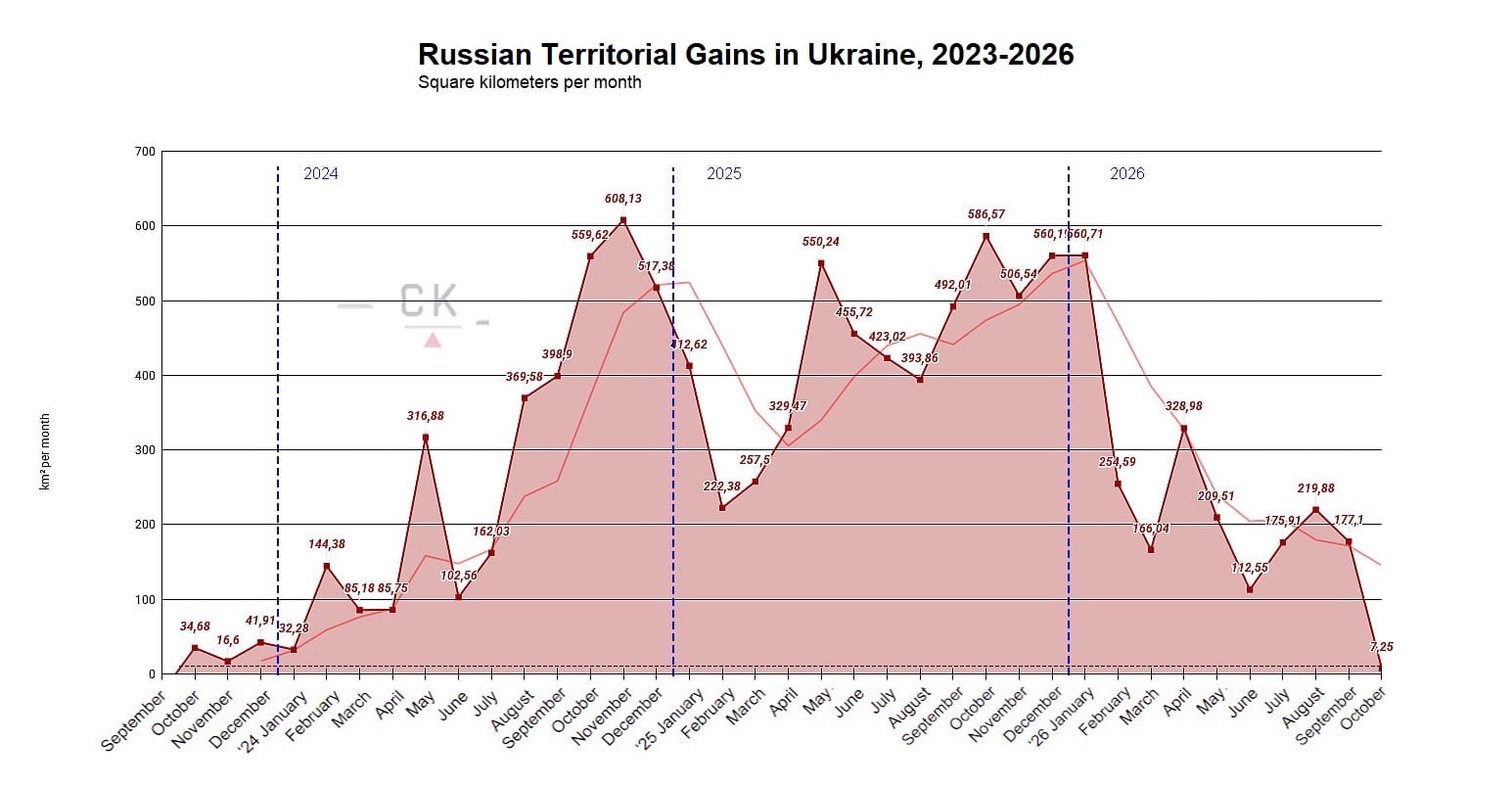
Notably, these figures are close to the territorial gains by the AFU reported by Volodymyr Zelenskyy: 10.4 km² in October. At present, the Russian advance is approaching zero when the territorial gains of both sides are taken into account. Starting in November, the pace of offensive operations is expected to decline further with the onset of colder weather and the loss of foliage.
The Security Service of Ukraine (SBU) reported on its Telegram channel that UAV operators of the Alpha Special Operations Center killed 2,146 Russian soldiers and wounded another 1,052 over the course of a week. This would amount to approximately 300 Russian soldiers killed per day, or more than 9,000 per month if extrapolated. This represents a substantial increase compared а with figures reported in previous months: 6,000 “neutralized” in July and August, and 7,600 in September. The SBU claims that this particular unit leads the Ukrainian Defense Forces in the number of enemy targets struck.
Meanwhile, the Unmanned Systems Forces reported that their drones killed approximately 300 Russian soldiers per day in October, which would amount to another roughly 9,000 killed per month. This means that just two formations reportedly account for 18,000 Russian soldiers killed per month.
In our assessment, the RuAF's total irrecoverable losses (those killed in action, permanently disabled personnel, prisoners of war, and deserters) may amount to approximately 25,000-30,000 personnel per month. If the Unmanned Systems Forces and Alpha alone account for 18,000 KIA, less than half of Russia's total irrecoverable losses would be left to account for all other categories of irrecoverable losses and the results of operations by all other Ukrainian military branches, including artillery. If our estimate were incorrect and Russian losses actually reached nearly 50,000 per month, as claimed by various sources, the situation for the RuAF along the frontline would already be critical, as losses would significantly exceed recruitment levels (approximately 30,000 personnel per month). In that scenario, we would expect to see a genuine collapse of the frontline rather than the current situation, in which Ukrainian and Russian territorial advances are roughly comparable.
One argument supporting the credibility of Ukrainian figures on Russian losses is the e-points system and the verification of strikes through the Delta situational awareness system. However, we see no reason to assume that publicly released reports necessarily correspond to the actual statistics of units recorded in the internal system.
Michael Kofman is also skeptical of some Ukrainian public claims. In a podcast with a serviceman from the AFU's 3rd Corps, Kofman asked him not to cite an unrealistic casualty ratio between the two sides.
The Economist has estimated that between 374,000 and 770,000 Russian military personnel have been killed, with total casualties, including the wounded, estimated at between 1.4 million and 2.1 million. Many Russian-language media outlets ran headlines featuring only the upper bound, even though the difference between the upper and lower estimates exceeds the lower estimate itself, making it incorrect to present 770,000 as an established death toll. For comparison, by Oct. 30, BBC News Russian and the independent Russian media outlet Mediazona, together with volunteers, had established the names of 285,023 killed Russian soldiers. If we still assume that open sources account for 45-55% of deaths and that our previous formula works (though we no longer believe this to be the case), the actual number of Russian military personnel killed would be approximately 520,000. Due to high drone activity and an extremely low rate of advance, the recovery of bodies from the gray zone is difficult, and deaths are recorded in obituaries and government registries only after substantial delays. Therefore, a more complete picture of casualties for 2026 will likely emerge only in a year or two. The estimate of "around half a million killed" appears plausible, but the available data do not allow us to confirm or rule out The Economist's upper estimate of 770,000.
The humanitarian operation in occupied Oleshky ended on the evening of Nov. 1. According to the latest figures, about 750 people were evacuated from the town (both sides decided not to disclose the exact number). Most of those who wanted to leave went to Ukraine, traveling by air from Anapa to Gomel and then by bus through Belarus. Some residents chose to go to Russian-controlled territory. Thousands of people remain in the town and its outskirts, so humanitarian missions need to continue.

The General Staff of the AFU and other Ukrainian military officials said Russian forces used the ceasefire to rotate personnel and bring up equipment and munitions. This does not, however, suggest that Russia is preparing an offensive against the city of Kherson: the Dnipro remains a formidable obstacle, and Russian troops cannot supply a large force on the river's right bank. Earlier, Sky News, citing Ukrainian marines, also reported ceasefire violations by the RuAF and published footage purportedly showing the violations. However, Dmytro Lubinets, the Ukrainian Parliament Commissioner for Human Rights, did not confirm these allegations.
Yana Lantratova, the Russian Commissioner for Human Rights, said the Russian side is doing everything it can to help citizens and protect their rights. But Russia, as the occupying power, bears direct responsibility for protecting civilians who remain in Oleshky and for meeting their basic needs. Russian authorities could have evacuated residents from the dangerous area near the front line much earlier. The evacuation should continue even after the joint humanitarian operation has ended.
The US State Department has approved the sale of 500 PAC-3 MSE interceptor missiles to Ukraine for $2.1 billion, but deliveries are not expected before 2030. To obtain the munitions sooner, Ukrainian officials are proposing that the United States and other partners transfer PAC-3 missiles from existing allied stockpiles and replenish them later with missiles produced under the new contract. Such an exchange is technically feasible, but it requires a political decision by the US administration and the consent of countries holding PAC-3 stockpiles.
Former Ukrainian Marine Dmytro Putiata considers automated turrets equipped with 12.7mm machine guns ineffective against jet-powered UAVs. As an example, he cites a Ukrainian private company that deployed 50 such systems in eastern Ukraine: in April, they shot down only six conventional Shahed drones with piston engines. Despite the limitations of these turrets, we believe these figures do not reflect their effectiveness as point-defense systems. They can engage drones directly attacking the facilities they protect, but are practically useless against targets merely flying past them.
Putiata also notes that air defense effectiveness depends primarily not on the specific weapon system, but on target detection and tracking: the density of radar coverage, software integration, and command and control of air defense crews. Without these elements, even modern interceptor drones cannot operate effectively. We have also previously emphasized that the main challenge in air defense is detecting targets and guiding weapons onto them, making investment in the development of ground surveillance radars particularly important.
Putiata considers ground robots overrated, a view with which we do not entirely agree. Contrary to our initial skepticism, they have already found applications in supply delivery, the evacuation of wounded personnel, and auxiliary tasks during combat operations — for example, distracting the enemy. At the same time, communications remain a significant limitation: because of their low operating altitude, ground robots are more constrained by the radio horizon. Consequently, if Starlink satellite communications are disabled again in the future, their effectiveness will be substantially reduced.
Ukrainian and Russian Strikes
Over the weekend, Russian forces carried out two prolonged, large-scale aerial attacks on Ukraine. The Ukrainian Air Force published two reports within 24 hours. During the Nov. 1 attack, Russia deployed significantly more piston-powered Shahed drones than it has typically used in recent weeks. This was weather-related: a solid layer of low clouds covered Kyiv and the surrounding region, making it harder for mobile fire teams (as well as interceptor-drone operators) to visually detect and track slow-moving UAVs. As a result, the effectiveness of mobile fire teams declines in such conditions. In clear weather, Russian forces tend to use faster jet-powered drones instead.
Meanwhile, balloons carrying small fixed-wing drones were once again spotted over Russia. The drones then detach from the balloons and head toward their targets. Ukrainian forces are likely using this method to complicate Russian air-defense operations and trigger prolonged airport restrictions as part of Operation M&Ms. However, balloons depend on wind direction and are almost impossible to steer, limiting their use to days with favorable winds and preventing them from disrupting airport operations for extended periods.
In Russia, authorities have begun installing walls made of shipping containers to protect key facilities from UAVs. Such structures can be erected much faster than concrete barriers, but their effectiveness will become clear only once information about the results of strikes becomes available.

Despite reports of a potential operational pause, Ukrainian strikes against Russian oil refineries remain ongoing. Ukrainian officials cited by The Kyiv Independent say that no order had been issued to halt the attacks. Instead, Ukrainian authorities decided to temporarily refrain from publicly claiming responsibility for them to avoid worsening relations with the Trump administration. A source close to the US administration told the outlet that the CIA continues to provide Ukraine with intelligence on the locations of Russian air defense systems needed to plan long-range strikes.
On Oct. 31, UAVs struck an oil refinery in Bashkortostan [Russia's constituent republic], and on Nov. 1, another refinery in Kstovo, Nizhny Novgorod region. Photos and satellite imagery can often reveal damage to atmospheric-vacuum distillation units (AVT units), but this is not enough to assess how long a refinery will remain shut down. Even severely damaged refineries often resume operations relatively quickly. Damage to more complex deep-conversion units, including catalytic cracking units, may prove more critical, as repairs require imported equipment (although they are harder to hit).


Following the drone attack on the oil refinery in Kstovo, long queues formed at gas stations across Nizhny Novgorod region amid concerns about possible fuel supply disruptions. Authorities urged residents not to stockpile fuel and later limited gasoline sales to 40 liters per vehicle and banned filling portable fuel canisters.

We need your support to continue our efforts. Please consider making a monthly donation to CIT through our fundraising page or Patreon.