Sitrep for Oct. 22-29, 2026 (as of 10:00 a.m. UTC+3)
Frontline Situation Update
In his new podcast, Michael Kofman discussed Operation Vivaldi in the Lyman direction with a former US serviceman, call sign "Jackie," who has been fighting on Ukraine’s side since 2022 and serves in the 3rd Army Corps of the Armed Forces of Ukraine. The service member said the start of the operation was deliberately not announced to avoid attracting unwanted attention from Russia's Ministry of Defense. It was assumed that if the media paid little attention to attacks on a given sector of the frontline, the Russian response there would be weaker. We are still not sure that this actually works that way. Judging by public statements, Putin and General Valery Gerasimov, Chief of the General Staff of the RuAF, understand the situation on the frontline so poorly that they genuinely believe that Operation Bear's Corner—a nonexistent "pocket" in the Kharkiv region—is real, and that 6,500 km² of territory have supposedly been captured since the beginning of 2026. However, it is possible that Gerasimov is in fact informed about the situation on the frontline through reports from the commanders of Russian force groupings. We believe those commanders, for their part, are at least broadly aware of what is happening in the directions they are responsible for — for example, that the towns of Kostiantynivka and Dobropillia have not been captured. At the same time, it would be strange to expect the Russian side to publicly acknowledge the AFU's successful offensive operations and its own retreat. The redeployment of reserves to threatened directions usually receives little coverage in pro-Russian Telegram channels, while some reports of Ukrainian activity in the Lyman direction did appear despite an information blackout—not only in independent channels, but also in Z-channels. As Jackie noted, the 3rd Army Corps of the AFU, formed around the 3rd Separate Assault Brigade, the Azov Brigade, does not need help from the Unmanned Systems Forces, because the corps has its own drone operators. In preparing for Operation Vivaldi, the command carefully studied the principles of corps-level combat: which tasks remain the brigades' responsibility, and how to coordinate all units and set the conditions for the brigades to carry out their tasks. Separately, the corps worked on coordination at the junctions of different brigades’ areas of responsibility. It is worth noting that such junctions are generally weak points in the defenses of both sides: in particular, the RuAF have regularly tried to attack in these areas.
According to Jackie, the main problem with Russian commanders is that, particularly at the highest levels, they are political figures rather than military professionals. They place much more value on favorable reports than on actual developments on the battlefield. The RuAF as a whole have become dependent on infiltration tactics, paying little attention to preserving the lives of their personnel or preparing defenses in the positions they capture. This makes it easier for the AFU to conduct counterattacks and renders the frontline even more porous than previously thought.
In preparing for the operation, Ukrainian troops used UAVs to deliver ground robots to the Russian rear, a tactic we have previously described. The robots were fitted with explosives, turning them into self-propelled mines, as well as grenade launchers. The grenade launchers distracted Russian assault troops, who believed they were being fired upon by Ukrainian soldiers who had infiltrated their rear. This allowed Ukrainian troops to approach Russian positions unnoticed. The AFU also used a remotely controlled BTR-60 armored personnel carrier loaded with explosives to clear a route of anti-personnel mines and test RuAF defenses. If the armored personnel carrier did not come under fire, the defenses in that area were weak enough to send in assault groups. According to Jackie, all such vehicles reached their targets, demonstrating to the command that the territory could be liberated.
While preparing for the operation, the 3rd Army Corps organized eight-person assault groups, each consisting of six infantrymen and two UAV operators. In addition, UAVs provided cover from the rear. This was rather unusual since UAV operators are usually stationed in the near rear with generators, internet access, and food supplies. Kofman called these troops "FPV infantrymen." Operating alongside the infantry allows them to coordinate strikes more quickly. Additionally, drones flying close to their operators are more difficult to jam because the control signal is likely stronger than that of the jammer. Although the risk of detection increases, the operators can quickly change positions. All of this helped make the Ukrainian assault groups more effective.
Additionally, while preparing for Operation Vivaldi, the AFU deliberately forced Russian UAV operators into specific positions by striking all other positions. After the assault began, the AFU destroyed these known positions, leaving the defenders without drone support.
Ground robots handled approximately 90 percent of evacuations and 80 percent of logistics in the Lyman direction. Operating from the rear enables their crews to perform far riskier operations than conventional evacuation teams can without endangering themselves to the same degree. This greatly supports troop morale. Similarly, an infantryman operating as part of a group feels more confident than a Russian assault trooper advancing alone or with one other soldier as part of an infiltration operation.
In conclusion, Jackie said that, although the operation was initially planned to consist of four "seasons," a fifth is now planned. The AFU has already crossed the Zherebets River and is fighting east of it. This confirms our previous observations that Ukrainian gains are not limited to those announced during the fourth "season."
Operation Vivaldi has already become one of Ukraine’s most effective offensive operations. In terms of the area of territory liberated, it has surpassed the AFU’s 2023 counteroffensive in the Zaporizhzhia direction. The 3rd Corps’ success was not due to the quantity of resources available. According to Jackie, no reserves were allocated for the operation. Its main advantages were the quality of command, including the ability to manage available resources, and careful strategic planning. The commanders identified the enemy’s weak points and worked out how to exploit them most effectively. Jackie believes the AFU will be able to continue exploiting these vulnerabilities for a long time, as the RuAF will be unable to adapt their tactics quickly.
In addition to the territory east of the Zherebets River, where the AFU presence had been recorded around the villages of Terny and Yampolivka and south of the village of Zarichne, Ukrainian troops have also been spotted south of the Operation Vivaldi area. For example, Russian drones struck Ukrainian positions in the village of Ozerne, southwest of the village of Yampil.

The AFU continues clearing the area, but the situation for Russian forces there cannot be described as critical: soldiers are not fleeing in panic, and no catastrophe has occurred. The Russian command has redeployed one of its most effective drone formations to the Lyman direction: the 50th Varyag Unmanned Systems Brigade. We therefore do not expect these Ukrainian successes to trigger a new wave of mobilization in Russia.
Another lesson from the Ukrainian offensive is that an operation’s success depends directly on the ability to coordinate different branches of the military effectively, including unmanned systems. Drones and robots do not replace infantry and armored vehicles.
The situation in the Sloviansk–Kramatorsk direction has effectively stabilized. We have not recorded any westward advances by the RuAF there in recent weeks. We directly attribute this to personnel changes in the AFU command initiated by Mykhailo Drapatyi. Emil Ishkulov was appointed commander of the 11th Army Corps, which is responsible specifically for this direction. It appears that the appointment is already producing results.
In the Velyka Novosilka direction, Ukrainian forces are advancing ever closer to the village of Velyka Novosilka and have already reached the village of Vesele. This is evident from footage released by the Russian Rubikon drone unit, which was striking AFU positions near the village. We will once again emphasize the importance of effective combined-arms warfare and organized defense: even an elite unit cannot stop Ukrainian offensive operations on its own.

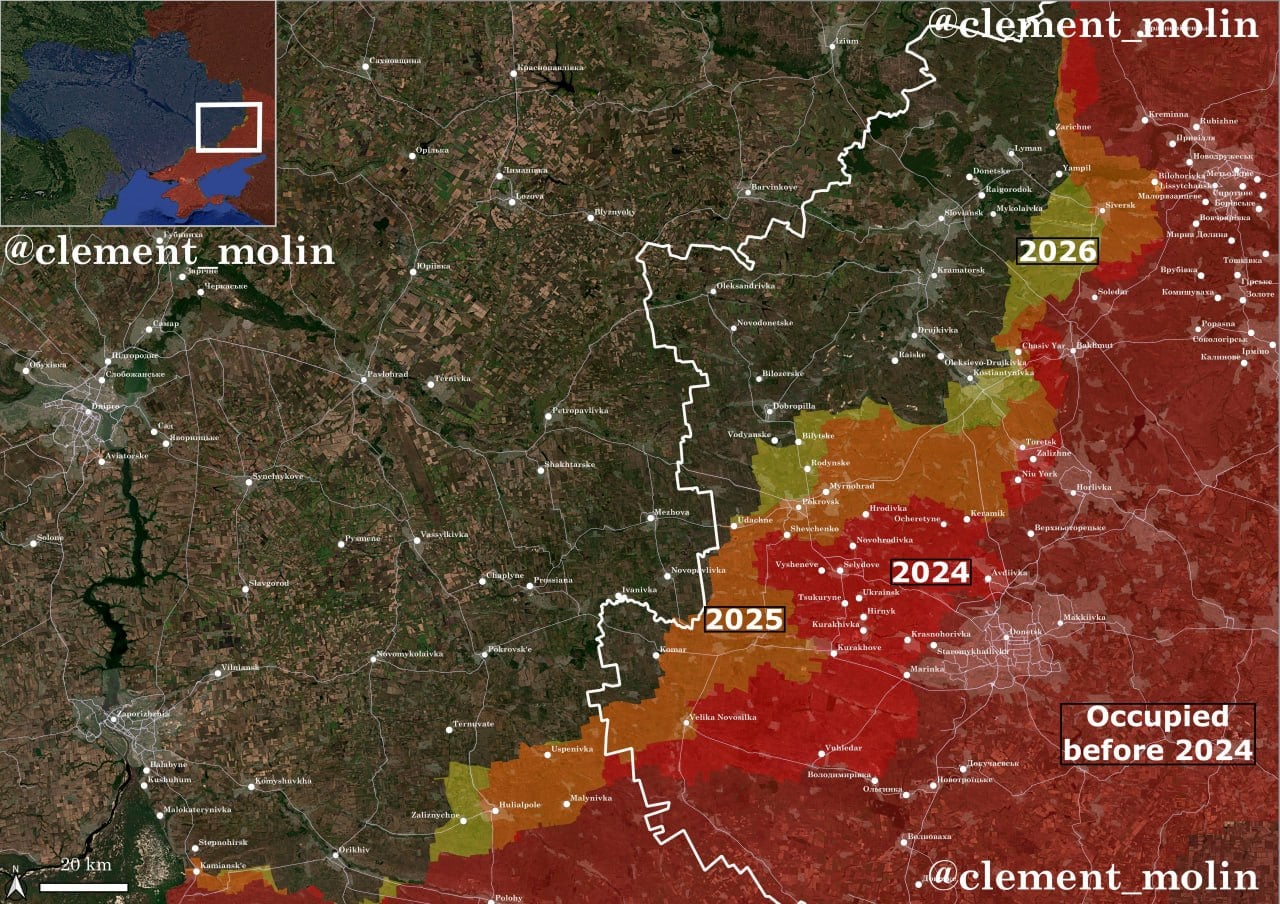
French researcher Clément Molin has published an infographic comparing the rate of advance of the RuAF across different years: in 2026, significantly less territory was captured than in 2024 and 2025—the lowest rate since the start of the full-scale invasion. We continue to note a slowdown in the Russian advance, but we try not to call it a "failure": overly emotional assessments create an exaggerated impression of the problems within the RuAF. For a long time now, they have adhered to the same tactic of total infiltration, the results of which are fairly weak: the rate of advance is low, and losses are extremely high. Incidentally, Jackie compared this approach to the actions of the US Army: if an attack fails, American soldiers fall back, devise new tactics, and attack again. The RuAF, however, repeats the exact same thing time after time, regardless of the outcome.
Over the past week, servicemen of the 475th Assault Regiment evacuated two severely wounded soldiers from other units using the first Ukrainian heavy medical drone, StarGate—in our previous sitrep, we reported on the first successful evacuation carried out with a similar UAV. Both wounded Ukrainian soldiers were in the contested zone approximately 5 km from the border with Russia, likely in the Kharkiv region. Due to difficult terrain, bodies of water, and the threat posed by Russian drones, ground evacuation was impossible. Ultimately, giant drones were deployed, which this time transported the soldiers not simply on a harness, but inside special capsules. Although both evacuations ended successfully, this method has its weaknesses: these drones are very large (though significantly smaller than helicopters) and noisy, making them relatively easy to spot. Such evacuations require allocating additional resources for air cover, so there is no question of scaling up at the current stage of technological development. Nevertheless, in certain cases, such an evacuation may be the only chance for the wounded, so it will continue to be practiced in exceptional situations.
Ukrainian and Russian Strikes
Ukrainian company Nova Poshta has reportedly launched a private air defense initiative that has already begun successfully shooting down Shahed-136 (Geran-2) loitering munitions, according to reports. Viacheslav Klimov, co-owner of the Nova Group, emphasized that businesses can take on tasks previously considered the exclusive responsibility of the state.
Yurii Ihnat, Head of the Communications Department of the Air Force of the Armed Forces of Ukraine, said that if the current pace of Russian attacks continues, the number of ballistic missiles launched at Ukraine in a single month could exceed 300. Based on the standard requirement of two PAC-3 interceptor missiles per ballistic target, intercepting them all would require approximately 600 missiles. That is roughly the current annual production volume of these missiles. In practice, Ukraine uses fewer interceptors, and some targets are not intercepted at all, but these figures illustrate the scale of the Patriot missile shortage.
Attacks on Ukrainian bridges continue. After UAV strikes on bridges in Kyiv, air-dropped bomb strikes on bridges in the city of Zaporizhzhia, and strikes with unidentified munitions on the Southern Bridge in Dnipro, the RuAF struck Kyiv’s Southern Bridge with four Iskander ballistic missiles on Oct. 27. Footage shows a large hole in the bridge deck, but the bridge did not collapse.
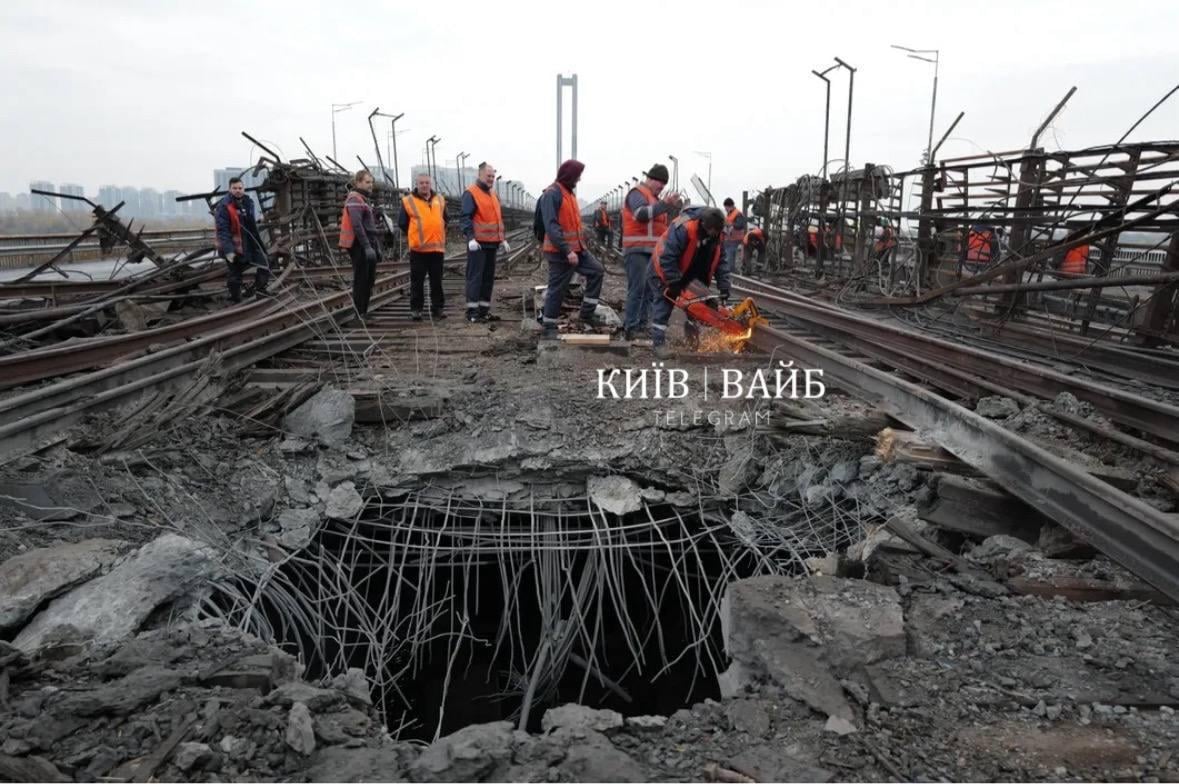
Collapsing a bridge span requires numerous precision strikes, so expending four scarce Iskander missiles on this target seems difficult to explain. The Russian MoD described the Southern Bridge as a combined road-and-rail bridge and claimed that military cargo was transported across it. However, the bridge carries road traffic and a metro line that enters tunnels on both sides. Regular passenger and freight trains do not run across it; indeed, it would be practically impossible for them to do so. The ministry provided no evidence of systematic military cargo transport along the bridge's road section.
The main consequences of the strike were damage to the bridge deck beneath the metro tracks and additional transport disruption for Kyiv residents.
A ceasefire is in effect around occupied Oleshky to allow civilians to evacuate. It will last until the evening of Nov. 1. The zone has been expanded beyond the town to give humanitarian convoys safe passage, but its exact boundaries are unknown. Russian and Ukrainian positions are separated by the Dnipro River, and the area covered is relatively small. So far, the ceasefire has held with no violations, which is rare in this war. Ukraine and Russia have also agreed on a way to exchange documents for their citizens. According to Ukrainian human rights ombudsman Dmytro Lubinets, these include employment records needed to confirm pension eligibility. Such requests continue despite the lack of diplomatic relations between the two countries.
Six days of ceasefire may not be enough to evacuate everyone who wants to leave. Thousands of people remain in Oleshky and nearby villages, and no large convoys have been seen so far. We can only hope that at least the most vulnerable residents will get out and that those leaving will not be subjected to filtration checks by Russian security forces.
The situation again shows the drawbacks of voluntary evacuation from combat zones. The presence of civilians not only puts them in mortal danger but also complicates fighting: Russian soldiers may be wearing civilian clothing, and the positions of both sides are often close to residential buildings. We believe people in areas of immediate danger should therefore be subject to mandatory evacuation and given safe housing and the help they need.
In recent weeks, Ukrainian forces have attacked Russian oil refineries, chemical and defense plants, and electronics factories almost daily. But footage of fires and destruction alone does not show how the attacks affect production. Even when a building is badly damaged, the most valuable equipment may survive, and a plant can sometimes be back up and running fairly quickly. It is therefore impossible to conclude from photos of the aftermath alone that Russia is running short of certain weapons components.
The CyberBoroshno project published satellite images of the Energiya plant in Yelets, in the Lipetsk region, which was hit by Storm Shadow missiles on Oct. 25. The images show four strikes on production buildings, destroyed roofs, and extensive signs of fire inside them. The damage appears serious, but the images do not allow us to determine whether production equipment survived or how quickly the plant could resume operations.

Conscription, Mobilization and Contract Military Service
The Vyorstka media outlet has surveyed human rights organizations and documented cases of coercion to sign contracts with the MoD in 33 Russian regions and annexed Crimea between Aug. 12 and Oct. 12. This coercion most frequently targets socially vulnerable men. While these methods have been employed before, their use is expanding as regions struggle to meet recruitment quotas through financial incentives alone, resulting in increased deception and pressure. This indicates growing problems with voluntary recruitment, although, as we expected, the second official wave of mobilization has not occurred.
In Omsk, relatives and acquaintances of recruits have reported that men have been abducted from the streets, beaten, and forced to sign contracts for military service at the Sirius-55 recruitment center. This was discovered through numerous reviews of Sirius-55 that appeared on online map service 2GIS. These reviews were later removed after a post by the Omsk Civil Association. Earlier in August, a 55-year-old father of four who was working as a janitor was taken from his place of work and later found at the same recruitment center, reportedly after signing a contract.

Meanwhile, regions are increasingly relying on intermediaries to recruit contract soldiers. In the Samara region, the 2027 budget includes, for the first time, a separate budget line of nearly 4.5 billion rubles [$55.87 million] for recruiter payments, which exceeds the entire budget of the regional Ministry of Security and nearly matches the sum planned for sign-up bonuses and other payments for military personnel.
Amid conflicting reports on restrictions affecting Starlink/Starshield and intelligence sharing with Ukraine, US lawmakers are attempting to determine the precise decisions made by the Trump administration. However, the Pentagon’s Inspector General has declined a bipartisan request from nine senators to investigate the reported restrictions, stating that the matter falls under the US Air Force’s jurisdiction. This response was unexpected, given that the request was directed to the Pentagon’s oversight body.
Meanwhile, Democrats have demanded that major US banks and certain ports preserve documents related to the Trump administration’s diesel deal with Russian authorities. If the Democrats secure a majority in the House of Representatives, investigating this deal will become a priority. According to recent reports, US companies have decided against purchasing Russian diesel due to potential risks.
Even if Democrats win in the November elections, US policy toward Ukraine will not change overnight. Decisions regarding intelligence sharing and satellite communications are made by the executive branch, and the new Congress will not convene until January 2027. However, if Democrats gain control of the House of Representatives, they could initiate investigations, issue subpoenas for documents, and summon individuals such as Pete Hegseth, Elon Musk, and others to testify under oath. Journalist Yevgeny Feldman has released a video explaining the possible consequences of the election results.
We need your support to continue our efforts. Please consider making a monthly donation to CIT through our fundraising page or Patreon.