Sitrep for Nov. 23-26, 2026 (as of 8:00 a.m.)
Frontline Situation Update
Nearly a week after the Armed Forces of Ukraine announced Operation Bear Trap in the Kharkiv region, no new visual evidence has been published. As a reminder, the footage initially released did not substantiate the claimed scale of the operation. Nevertheless, we have no doubt that Ukrainian offensive operations achieved some local successes, clearing a number of positions and pushing Russian forces back in several areas.
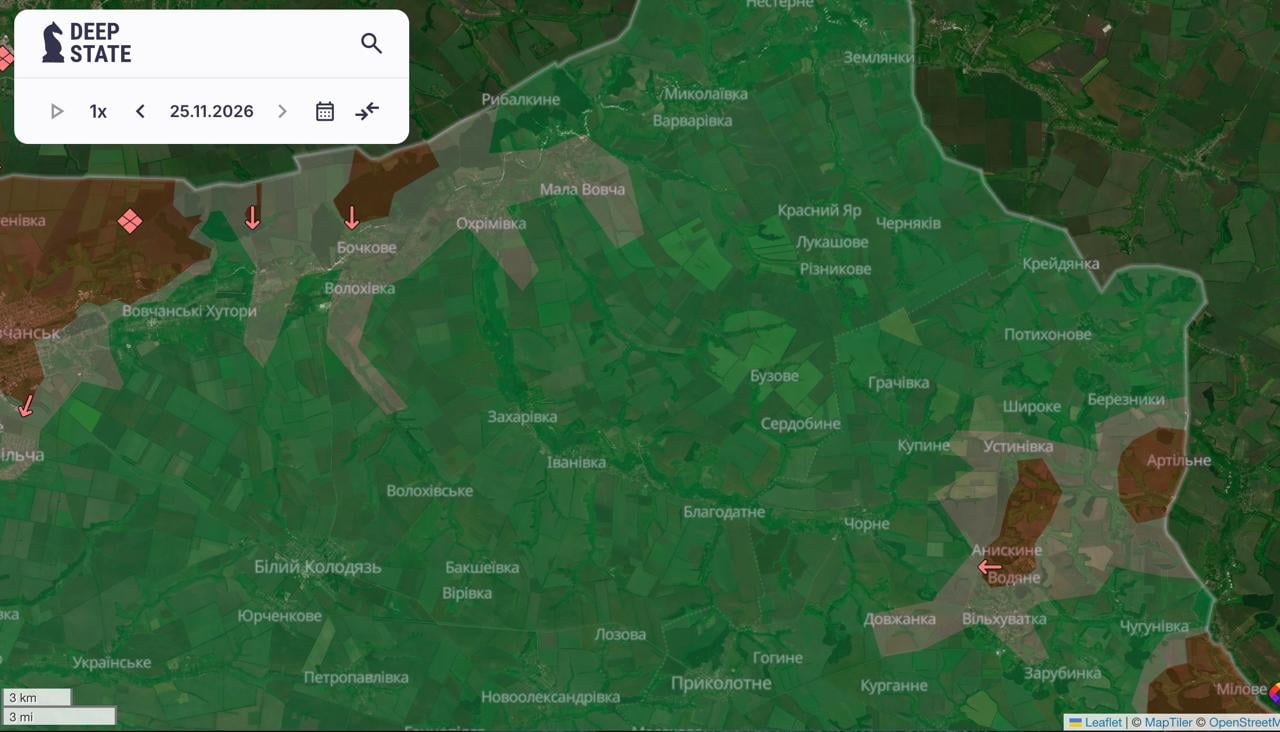
Russia's Group of Troops "North," in turn, responded with flag-planting photo ops intended to disprove Ukrainian claims of success. The appearance of a soldier holding a flag on the western outskirts of the village of Vilkhuvatka thus refutes the 475th Separate Assault Regiment's exaggerated claim that the village had been liberated, but not the conclusion reached by us and other analysts that Vilkhuvatka remains in the contested area. Meanwhile, the Russian side has failed to explain why Ukrainian forces are operating in territory supposedly under Russian control.
In addition, the group's Telegram channel published flag-planting footage filmed in areas Ukraine had not claimed to have liberated, including the villages of Lukashove and Riznykove. As always in such cases, footage of a lone soldier emerging from cover to display a flag to a drone does not establish control over an entire settlement.

It is also noteworthy that the infographic featured in the video shows the entire border area of the Kharkiv region where Operation Bear's Corner took place, during which Ukrainian troops were allegedly encircled. Meanwhile, the area that the AFU’s 475th Separate Assault Regiment claimed to have liberated is relegated to a corner of the map and shown in little detail.
This week, unsubstantiated reports of a new Ukrainian operation in the Kursk region began circulating across various sources, prompting AFU's 8th Air Assault Corps to issue an official denial. The statement noted that posts claiming the establishment of a new Ukrainian foothold cited the Institute for the Study of War (ISW). ISW, however, pointed out that reports of fighting along the border in the Sumy region did not indicate a resumption of Ukrainian operations in the Kursk region. The Ukrainian military suggested that someone had most likely misinterpreted reports of an improved tactical position in one sector of the frontline.
At the same time, on Nov. 19, that same AFU’s 8th Air Assault Corps published footage of a HIMARS missile strike on the command post of the 2nd Battalion of the 145th Regiment of the 810th Naval Infantry Brigade of the Russian Black Sea Fleet on the outskirts of the village of Krasnooktyabrskoye in the Kursk region. On Nov. 23, a missile strike, likely from a HIMARS MLRS, on a base in the village of Snagost (not far from Krasnooktyabrskoye) killed 11 servicemen and wounded eight more, according to a report from the insider Telegram channel Dos’ye Shpiona [Spy Dossier]. Given that on Nov. 23 the 8th Air Assault Corps reported that Rubicon S, an unmanned special-purpose unit, was hit in Rylsk, we cannot conclude that the strikes on Krasnooktyabrskoye and Snagost are the same event. It is worth noting that HIMARS has rarely been used recently.
Both sides continue to take advantage of the bad weather to conduct evacuations, troop rotations, and resupply operations, because drones have a harder time operating. Russian forces tried again to exploit the bad weather to launch armored attacks.
In the Huliaipole direction, two armored vehicles carrying infantry drove from the direction of the settlement of Zaliznychne toward the village of Staroukrainka. Despite the fog, Ukrainian drone operators spotted the vehicles and knocked them out before they could reach the AFU positions.
In the Dobropillia direction, observers documented a similar attack attempt: in windy weather, an infantry fighting vehicle and an armored personnel carrier drove from the direction of the town of Pokrovsk toward the town of Dobropillia. Ukrainian troops also spotted them in time and knocked them out near the village of Dobropillia.
Yet another Russian war crime has come to light: in the Sloviansk-Kramatorsk sector, a Russian FPV drone hit a white minivan in the city of Kramatorsk as Ukrainian volunteers were using it to evacuate four civilians. Despite the vehicle’s clearly visible markings, the Russian Armed Forces struck it anyway. The strike killed two people and wounded two more. Kramatorsk is still not on the frontline, but it has long been very dangerous for civilians to remain there.
Another similar strike recently took place in the village of Komyshuvakha, in the Zaporizhzhia region, where civilians were being evacuated after a Russian airstrike had already killed 72 people. A Russian drone struck a white pickup truck marked "Relief Coordination Centre," the name of a Ukrainian civilian organization that, among other things, evacuates civilians. Russian Telegram channels that published this video said the drone was flown by a cadet "drone operator."
Conscription, Mobilization and Contract Military Service
According to German economist Janis Kluge, 34,000 people signed contracts with the Russian Ministry of Defense (MoD) in October. This figure exceeds the monthly average of 30,000 but is 10 percent lower than in October 2025. Overall, in nearly every month of 2026, recruitment was about 10 percent lower than in 2025. Since the beginning of 2026, a total of 297,000 people have signed contracts with the MoD.

In early November 2026, the Belarusian Cyber Partisans and Silent Crow hacking groups breached the database of the Federal State Statistics Service (Rosstat) and provided the data to journalists. Since then, several media outlets have examined the data and compared it with information already available. The first such analysis we will consider is a joint report by Mediazona [independent Russian media outlet] and Meduza [international Russian-language online media outlet]. The researchers estimate that by the fall of 2026, the number of Russian soldiers killed in the war may have reached about 720,000. The database contained records of at least 490,000 deaths, which the researchers were able to verify using other information available to them. They also reviewed their data on people listed as missing in action and estimated the number of soldiers killed whose deaths had not yet been entered into the leaked Rosstat database. These estimates put the total number of Russian soldiers killed in the war at about 720,000, or approximately one in every 200 residents of Russia. The challenges in making these estimates included filtering out irrelevant records and properly accounting for mobilized men from the so-called Donetsk People’s Republic (DPR) and Luhansk People’s Republic (LPR), recruits in the Wagner Group, and senior officers whose deaths are often concealed.

Vazhnyye Istorii [IStories, independent Russian investigative media outlet] has also analyzed the leaked Rosstat database and estimated the trend in Russian military deaths. Since records of deaths can take months, and sometimes years, to be entered into the database, figures for 2026 remain incomplete. The data for 2025 already allow for more confident conclusions: according to the journalists’ tally, an average of 584 Russian servicemen were killed each day that year. When deaths not yet recorded in the database are taken into account, the number rises to about 660. The peak was in May 2025, when the average daily death count was estimated at about 730. This amounts to around 22,600 deaths for the month. When seriously wounded personnel who will no longer be able to return to duty, prisoners of war, and other categories of irrecoverable losses are included, the monthly total is consistent with our earlier estimate of more than 25,000 people per month during periods of the most intense fighting.

However, the widely used formula of "one killed for every three wounded" cannot be applied to the death toll to put overall Russian military losses at nearly 3 million. Mediazona editor Maksim Litavrin noted the ratio does not apply to the current war. There is no reliable figure for the wounded, and the nature of injuries, access to evacuation and the share of troops returning to duty vary widely by period and sector of the frontline. For that reason, we have not published estimates of total wounded for several years.
Overall, the analysis of the leak confirms that actual losses are close to the upper end of independent estimates. Mediazona previously said its list of obituaries covered 40% to 60% of all losses, and its latest count of 289,000 is roughly 40% of 720,000. Still, that does not automatically make Ukrainian claims credible, whether 30,000 to 35,000 Russian troops killed each month or, later, about 50,000 irrecoverable losses. Such figures are usually published without an open methodology that would allow anyone to check them. They are also hard to square with Ukrainian leaders' statements that the size of the Russian force has remained stable, assuming current recruitment has long failed to cover the claimed losses (we await the next assessment of the size of the Russian force).
Ukrainian and Russian Strikes
In recent attacks on bridges, Russia has used ballistic missiles, including what are believed to be North Korean KN-23s, although Iskander ballistic missiles may also be used for such strikes. Over the course of the year, Ukraine has repeatedly targeted facilities involved in the production of these missiles. On Feb. 21, a Flamingo missile hit one of the workshops at the Votkinsk Machine Building Plant in Udmurtia [Russia's constituent republic]. Initial satellite imagery showed a large hole in the roof, but it was then impossible to assess damage to equipment inside the building. New imagery now shows that the damaged workshop has been completely demolished. This indirectly suggests that restoring the building was deemed impractical and that the damage was more serious than could be determined immediately after the attack. At the same time, this was only one workshop at a large enterprise, and there is no indication so far of a significant shortage of Iskander missiles in the RuAF. Nevertheless, such strikes may complicate production, particularly if unique equipment is damaged or a bottleneck emerges in the production chain.

At the same time, the Financial Times reported that the Pentagon has still not approved the transfer to Ukraine of approximately 60 Patriot interceptor missiles that have already been allocated for Ukraine. These missiles were paid for by Ukraine's Western allies, rather than being transferred free of charge from US stockpiles. According to the publication, Ukraine received eight fewer PAC-3 missiles than planned in September, 10 fewer in October, and another 10 fewer in November. This means that only four missiles were delivered in September, and two each in October and November. Another 12 are scheduled for December, but none have been delivered yet. Since the month has not started, however, it is too early to consider this batch overdue. Thus, as of the date of publication, the transfer of 28 PAC-3 interceptors had been delayed. In addition, approximately 20 PAC-2 missiles have already been allocated to Ukraine, which, in our assessment, are likely to come from European stockpiles. However, US Secretary of Defense Pete Hegseth has still not signed off on their transfer.
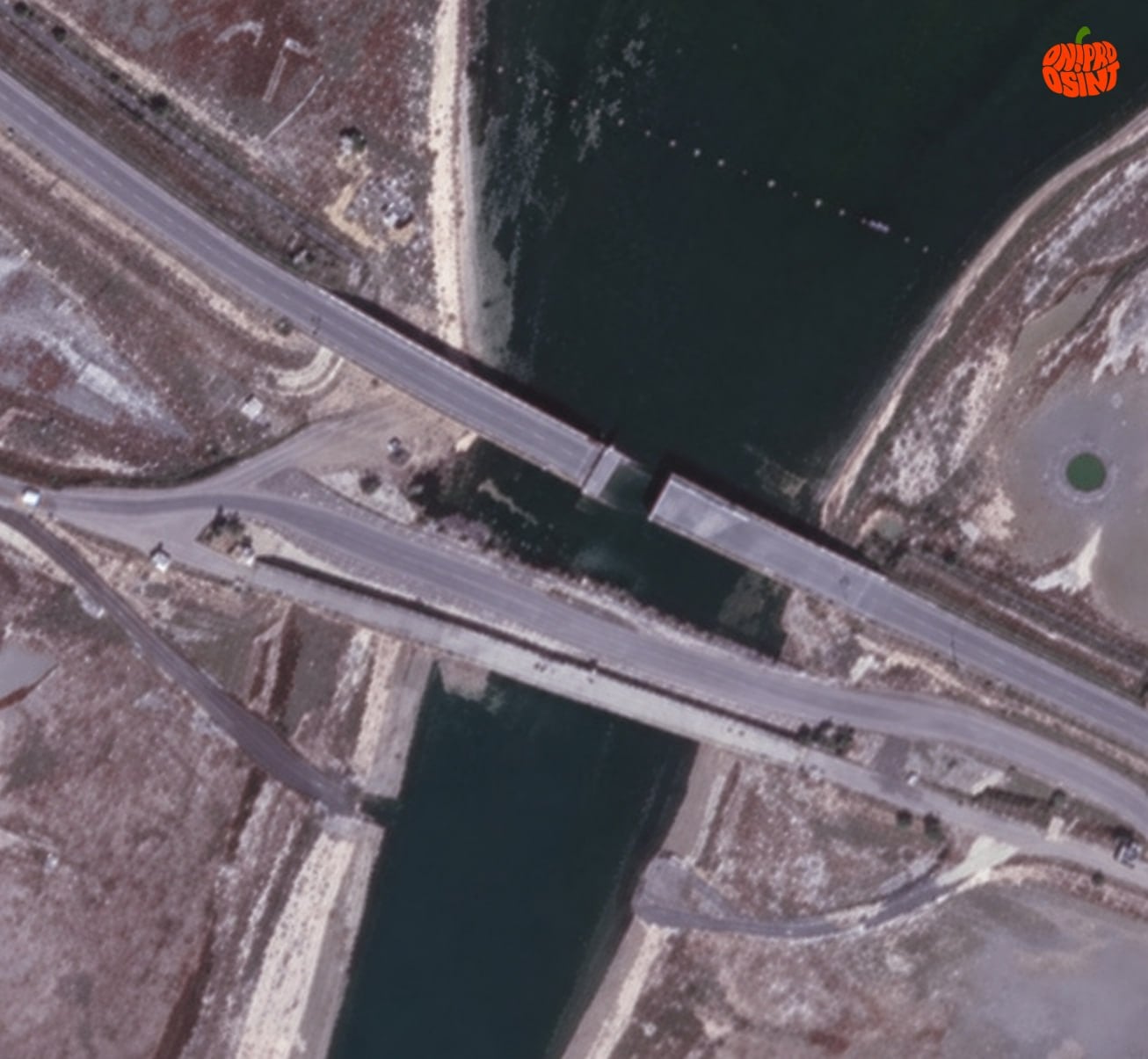
In late October, satellite imagery appears to show that work began on a pontoon crossing over the Dnipro River in Zaporizhzhia. Its purpose has not been officially announced, but the Ukrainian authorities are likely preparing an alternative route in advance in case of further Russian strikes on bridges. This requires not only assembling the pontoon sections but also preparing access roads on both riverbanks.
A video has emerged showing the Chonhar road bridge, one span of which collapsed following Ukrainian strikes in the summer of 2026. Judging by the footage, a replacement span has already been installed, and reconstruction is nearing completion. This example shows that, after relatively localized damage, a bridge can be returned to service within a few months, although its capacity remains limited while repairs are ongoing.
The General Staff of the AFU reported a strike on Savasleyka airfield in the Nizhny Novgorod region, where MiG-31K fighter jets, carriers of Kinzhal air-launched ballistic missiles, are based. According to the Ukrainian side, three MiG-31Ks and two Su-34 fighter-bombers were hit. There is currently no independent confirmation of these claims due to heavy cloud cover. In general, such weather in the fall and winter complicates assessments of strikes on airfields, industrial facilities, and other targets, as well as analysis of changes along the frontline.
The Security Service of Ukraine (SBU) released new details of the operation off the coast of Libya. According to the SBU, seven Ukrainian-made unmanned surface vessels (USV) took part in the attack. They were delivered to the area near Benghazi aboard a mothership and launched from there. Thus, according to the SBU, the USVs were launched at sea rather than from the Libyan coast, as was initially assumed by some sources.
New satellite imagery of the port shows the sunken corvette Merkury, cargo ships from the convoy it had been escorting, and a makeshift barrier of small vessels and boats. Apparently, this is an attempt to protect the port from further USV attacks. It also indicates that Benghazi did not have a pre-prepared, comprehensive defense system against unmanned surface vessels before the attack.
In addition, the first information has emerged about crew members of the Merkury who were killed. An obituary was published for Captain 3rd Rank Aleksandr Tsulin, who, as of February 2025, served as the corvette’s deputy commander for personnel.

According to the obituary, he was killed near Benghazi on Nov. 21 while carrying out a "combat mission." A second crew member killed was Lieutenant Semyon Zabolotny, the head of the supply service responsible for the ship’s logistical support.

We need your support to continue our efforts. Please consider making a monthly donation to CIT through our fundraising page or Patreon.