Sitrep for Nov. 16-19, 2026 (as of 8 a.m. UTC+3)
Frontline Situation Update
According to researcher Playfra, the battle for the town of Bilytske in the Donetsk region has come to an end: after approximately nine months of fighting, Russian forces have gained full control of the town. This conclusion is based in part on the fact that Ukrainian troops have not been spotted there in recent days. We agree that Bilytske has been captured. The Russian Ministry of Defense reported its capture back in the summer, and even DeepState's map has shown only the town's northwestern outskirts as contested for the past week. A Ukrainian airstrike on Russian drone operators' positions in the eastern part of the town can be considered additional confirmation of its loss.


There have been no significant changes in the Kupiansk direction in recent days, but footage has emerged showing a strike on a Russian soldier in the Yuvileinyi neighborhood of the town of Kupiansk. This neighborhood was important to Russian forces last year, as the last supply route into Kupiansk for the Armed Forces of Ukraine at the time ran nearby. Since then, Ukrainian forces have managed to isolate the Russian salient and almost completely clear the town (part of Kupiansk is still shown as contested on the DeepState map). Thus, the appearance of a lone Russian assault trooper in the southern part of the town indicates only continued infiltration attempts, not an advance by Russian forces.
The town of Kostiantynivka remains entirely in the contested area, while Russian forces are also actively destroying the neighboring town of Druzhkivka with various types of weapons. In addition, Russian assault groups have been infiltrating Druzhkivka since August. At this stage of the war, when assault troops can infiltrate enemy rear areas, it is possible to distinguish not only the contested zone but also what could be termed an infiltration area, which may extend up to 15 km deep.
In the Orikhiv direction, Russian FPV drones struck a Ukrainian Sky Sentinel automated machine-gun turret armed with a 12.7 mm Browning machine gun. This is at least the second known instance of such a system being destroyed by an FPV drone. For reasons unknown, the turret does not open fire at the approaching drone in the released footage. It may have been switched off, out of ammunition, or failed to detect the target. As we have previously noted, the Sky Sentinel turret can engage targets only within a limited range and altitude, and can only be used effectively for point defense of specific sites.
Strikes on the Crimean Bridge
As we have reported, in the early hours of Nov. 16, Ukrainian drones and missiles struck the Crimean Bridge: one munition fell onto the roadway, and another hit the arch above it. The bridge was temporarily closed, but by evening, traffic resumed in one direction at a time. It was impossible to determine how badly the arch was damaged, because later that evening, authorities again declared an air-raid alert and halted traffic, and the span that the arch supported collapsed along with the arch in a combined strike. According to Volodymyr Zelenskyy, the new large-scale air attack involved various drones and cruise missiles: Dovbush, Vendetta, Da Vinci, Sichen, MICH 2000, Ruta, Palianytsia, An-197 Liutyi, FP-1, FP-5 Flamingo, and the R-360 Neptune subsonic cruise missile. In addition, published footage appears to come from a Flamingo missile's camera as the missile approached the surviving arch of the railway bridge.

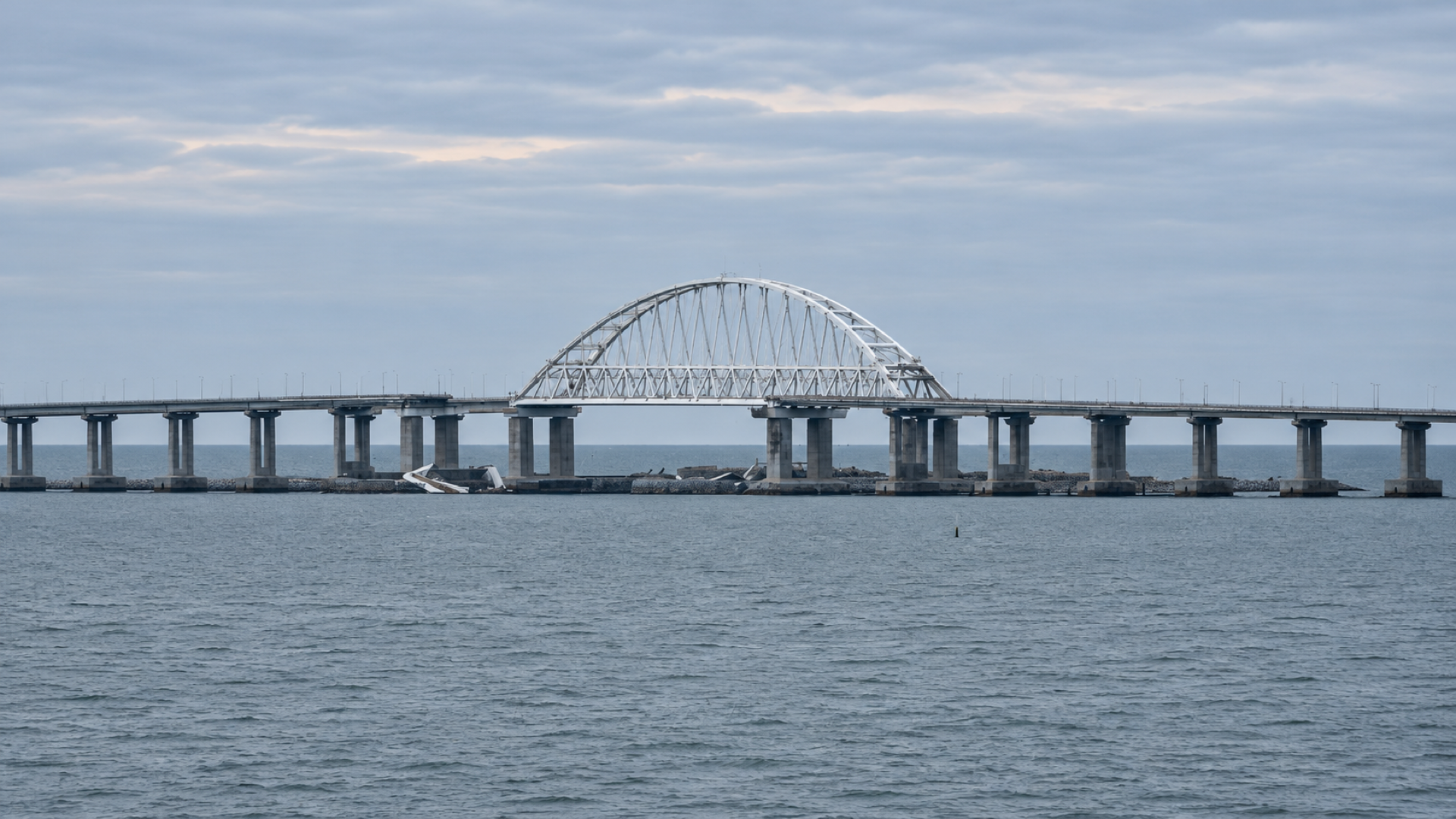
Later, rail traffic resumed, and footage of the collapsed span, filmed from a train window by passengers, appeared.

In the early hours of Nov. 19, strikes on the railway bridge continued, and hits were reported. The General Staff of the AFU said the bridge was struck with R-360 Neptune subsonic cruise missiles. Rail traffic was suspended, and there were no casualties, as on Nov. 16 and 17. Judging by satellite images, the strikes did not cause substantial damage to the bridge, and by the evening of Nov. 19, traffic resumed in one direction.

The collapse of the span matters not only because it has cut off road traffic between Crimea and the Krasnodar region for an extended period, but also because the arch and the span fell into the shipping channel in the Kerch Strait and blocked it. Large vessels can no longer sail between the Black Sea and the Sea of Azov. Another channel is still open, but as far as we know, only small craft can use it.
Like other analysts, we expected that the culmination of Ukraine's campaign of strikes against Russian air defense positions and logistics infrastructure in Crimea and in the occupied territories, including bridges, would be an attack on the Crimean Bridge.

We considered unmanned surface vessels the most likely choice for such an attack, given Ukraine’s limited supply of missiles and the relatively small warheads carried by drones. However, we also considered the possibility of a large-scale, combined attack involving both missiles and drones. Even ballistic missiles, however, would struggle to bring down the bridge, as the bridges in Kyiv demonstrate. From a military perspective, using a large number of missiles seemed hardly worthwhile: destroying the bridge in itself would offer no significant military advantage. Such an attack would make more sense as part of preparations for a large-scale ground operation in either the Kherson or Zaporizhzhia regions, for which, however, the AFU lacks the necessary forces.
Nevertheless, the Ukrainian military managed to identify a vulnerable point in the bridge’s structure and exploit it following careful preparation, which included suppressing air defenses. Particularly noteworthy was Zelenskyy’s statement that the road section of the bridge had been struck by Palianytsia missiles, while the railway section had been hit by R-360 Neptune subsonic cruise missiles and Ruta missiles. The Flamingo missiles, meanwhile, were used for what he described as a "guided strike." At the same time, the Security Service of Ukraine (SBU) also claims that Palianytsia missiles hit the road bridge. These missiles have a range of up to 650 km and carry warheads weighing up to 100 kg. Fire Point, for its part, claims that one Flamingo missile struck each of the two bridge arches, while the company Destinus says that seven Ruta missiles hit the arch of the road bridge, each carrying a warhead weighing at least 150 kg.
Another important aspect of this aerial attack is that the missiles did not simply follow pre-programmed coordinates: their flight paths were actively controlled, as evidenced by footage from the FP-5’s onboard camera. This revealed that Ukraine had managed to establish the use of mesh networks to maintain communications with missiles and drones in areas where Starlink and Starshield are unavailable. This is the same technology used by Russian drones in aerial attacks on Kyiv and Ukraine's western regions. To facilitate these operations, relay stations were deployed in Belarus. Ukrainian forces therefore appear to be capable of carrying out precision strikes approximately 250 km into Russian territory.
When Ukraine carried out the sabotage operation against the Crimean Bridge in 2022, a section of the road bridge also collapsed. However, the damaged section was relatively small, allowing repairs to be completed within several months. This time, the collapse involved the section where a 227-meter span was suspended from an arch—a complex and extremely heavy steel structure weighing 4,700 tons. The structural components were manufactured at the Voronezhstalmost plant, while the arches themselves were assembled in Kerch over the course of a year and subsequently lifted into position 35 meters above the water. It is difficult to estimate how much time, effort, and money will be required to restore the bridge under wartime conditions. The structures will have to be assembled, transported, and installed within range of Ukrainian weapons. Even clearing the navigation channel to restore maritime traffic between the two seas could take considerable time, particularly given that the area experiences a storm season approximately from November through March.
Frequent and unpredictable storms also complicate ferry operations. On Nov. 19, it was reported that the ferry service had been temporarily suspended due to adverse weather conditions. Nevertheless, recent satellite imagery showed that at least two ferries were operating between Crimea and Port Kavkaz.
To summarize: road traffic between Crimea and the Krasnodar region has been disrupted, although the ferry crossing remains available during favorable weather conditions. The R-280 highway—the so-called land bridge to Crimea—remains dangerous for both civilians and military supply operations to the peninsula. Furthermore, Ukrainian forces will apparently continue targeting bridges along this route, as well as the railway section of the Crimean Bridge. Even if the bridge cannot be rapidly destroyed, traffic is halted whenever air-raid alerts are issued.
The strike on the Crimean Bridge was primarily a symbolic and political gesture that, in itself, offers little military advantage (it is worth noting that the bridge does not appear to be used for transporting fuel). It is reasonable to view it as a response to Russian strikes on bridges, including those in Kyiv. The fact that the attack caused no casualties is particularly commendable: it took place at night, an air-raid warning was issued some time before the strikes on the bridge itself, and the bridge was closed to traffic in time. The Crimean Bridge is one of Putin's pet projects, so it is reasonable to expect a retaliatory response, most likely in the form of another large-scale strike on Ukraine. It is worth noting that, as we reported last time, there was a certain "lull" ahead of the negotiations in Abu Dhabi, which may also indicate that Russia is stockpiling weapons for another large-scale attack.
Ukrainian and Russian Strikes
In the early hours of Nov. 17, Russian forces once again attacked bridges across the Dnipro River in Kyiv. According to Zelenskyy, four ballistic missiles were launched at the Southern Bridge and three at the Northern Bridge. The Russian MoD claimed that both bridges were used to transport Ukrainian weapons and military equipment.

North Korean KN-23 missiles were likely used in the attack. Published footage shows that the missiles struck relatively close together, but neither bridge collapsed. These missiles are guided toward pre-programmed coordinates, and destroying a bridge requires several sufficiently accurate hits on its most vulnerable structural components. If KN-23 missiles were indeed used against the bridges, their accuracy has improved considerably. Zelenskyy stated that North Korea supplies Russia with dozens of ballistic missiles every month. However, the Russian command has to choose how to allocate them: against bridges or energy infrastructure.
The immediate consequences of the attacks on the bridges included traffic restrictions, the suspension of service on part of a metro line, and transport gridlock. Ukraine's Minister for Restoration, Infrastructure and Transport, Nikolay Kalashnik, stated that it would take two to three months to fully restore traffic on the Southern Bridge.
Ukrainian authorities are preparing alternative ways to cross the Dnipro. In Kyiv, they plan to build eight rapidly constructed bridge crossings on piers, two of which are already being worked on. These are not conventional pontoon bridges but more stable temporary structures with roadways.
At the same time, Ukrainian authorities are discussing a tunnel under the Dnipro with the American company Robbins. The project is still at the preparatory stage: a route needs to be selected, geological surveys conducted, and a feasibility study completed. The preliminary cost is estimated at around 500 million euros, with a minimum construction time of three years. If funding is insufficient or attacks continue, construction could take considerably longer. Thus, the tunnel is more of a long-term infrastructure project than an immediate solution to the current problems with crossings over the Dnipro.
Search-and-rescue operations have concluded in the village of Komyshuvakha in the Zaporizhzhia region following a Russian airstrike on Nov. 2. The death toll has reached 72, with four more people still listed as missing. Among those killed were first responders, police officers, medics, municipal workers, gymnasium staff, and four servicemen who had arrived to help following the initial strike. They included AFU Major Vitaliy Bevza, Captain Viacheslav Okolot-Radomskiy of the AFU’s 153rd Mechanized Brigade, and military medic Oleksandr Zalishchuk of the 1st Battalion of the 115th Territorial Defense Brigade. During subsequent debris-clearing operations, Russian forces attacked the site directly nine more times, wounding three police officers and four first responders. No evidence has emerged to substantiate Russian claims that a UAV command center was located in the school.

Su-34 fighter-bombers remain the primary carriers of Russian glide bombs. In October, Ukrainian forces reported destroying such aircraft at airfields in Maykop on Oct. 4, in the Voronezh region on Oct. 15, and in the Volgograd region on Oct. 29. According to our estimates, the total Su-34 losses that month were roughly equivalent to half of the annual production of these aircraft. However, these strikes have not yet resulted in a shortage of aircraft of this type or a noticeable reduction in Russian airstrikes: the Russian Aerospace Forces have a fairly large fleet of Su-34s, and production continues. The Rostec state corporation recently delivered another batch of at least two new aircraft to the military, just a few weeks after the previous delivery was reported. Thus, for now, Russia is primarily suffering financial losses while managing to replace the fighter-bombers it loses.
On Nov. 16, in Dnipro, two people were killed and 20, including a teenager, were injured in a large-scale Russian attack involving missiles and UAVs. Most of those killed or injured were on a busy city road. The available footage does not make it possible to determine whether UAVs deliberately targeted civilians or veered off course due to damage or electronic warfare. If the attack was deliberate, it was an obvious war crime.

In the early hours of Nov. 17, Ukrainian UAVs once again struck Kursk, targeting an electrical substation that supplies power to about 400,000 residents of the city and surrounding areas. The resulting power outages were brief, and there were no fatalities or injuries.
Unexpectedly, we find ourselves partly agreeing with Elbridge Colby, US Under Secretary of Defense for Policy, who stated at another Ramstein-format meeting that strikes deep inside Russian territory, especially those targeting civilian sites such as Wildberries warehouses, "have not been effective in driving an end to the war, nor do they contribute to blunting Russia’s advances on the front line." In his view, such attacks could instead harden Russian public resolve and the Kremlin’s willingness to escalate. Colby also stressed that Ukraine should not be forced to "fight with its hands tied behind its back," and spoke favorably of strikes on Russian frontline logistics and military targets within Russian territory.
Defense Minister Yevhen Khmara said Ukraine plans to more than triple its production of long-range jet-powered and propeller-driven drones in 2027. The scale of Ukraine's deep strikes has already grown noticeably this year. Russia's Defense Ministry periodically claims that Ukraine launched hundreds, sometimes even thousands, of drones in a single day. Those figures cannot be independently verified and may be inflated. Still, Ukrainian production has reached a level that allows it to stockpile large numbers of drones for large-scale attacks. Russia is also expected to step up its own long-range strikes. If current trends hold, the war will increasingly be shaped by attacks on energy facilities, airfields, depots, factories and transportation infrastructure deep behind the lines, rather than solely by shifts along the front, increasing the risks to civilians in both countries.
Another incident occurred in the Black Sea, this time outside the territorial waters of NATO countries. On Nov. 16, the Somali-flagged cargo ship Betul 8 sank about 77 kilometers from Bulgaria's Cape Kaliakra, in the country's exclusive economic zone. The vessel was carrying about 3,000 tons of Ukrainian wheat from the Romanian port of Tulcea to Egypt. All 12 crew members were rescued.
The ship was reportedly hit by two unmanned surface vessels, but Bulgarian authorities have not officially determined the cause or named a party responsible. Despite a string of similar attacks off the coasts of Romania and Bulgaria, there are no signs that NATO is preparing a permanent mission to escort commercial ships or intercept drones.
On Nov. 17, a Russian An-12 military transport aircraft en route from Novosibirsk to Kansk crashed in the Kemerovo region. The Dos’ye Shpiona [Spy Dossier] Telegram channel reported 17 dead, while the MoD stated that 19 people were on board and all of them died. According to the MoD's preliminary version, the cause of the crash was a technical malfunction. Eyewitnesses reported that the plane caught fire while still in the air. A fire may have started in one of the engines, after which the crew attempted to make an emergency landing in Kemerovo. There is no evidence that the aircraft was shot down by air defense systems or brought down by sabotage.
In Thailand, a court has sentenced 35-year-old Yaroslav Demidov and 38-year-old Dmitry Maskalyov to life imprisonment for the murder and dismemberment of Russian citizen Mikhail Yemelyanov. Both defendants pleaded guilty to the charges in full. Yemelyanov disappeared after meeting with Demidov in January 2026, having warned his relatives in advance that he feared for his life. Later, a ransom was demanded for the allegedly alive Yemelyanov from his mother, who had arrived to search for her son. His remains were discovered near a body of water not far from Pattaya, and Demidov and Maskalyov were detained in Bangkok. According to the victim's mother, the terms of their sentences prohibit visits, phone calls, and money transfers. According to journalists, both men had been serving sentences in a Russian penal colony, signed contracts with the MoD, and subsequently went AWOL. Criminal cases under the corresponding article were initiated against them in Russia. How exactly they left the country and ended up in Thailand is unknown. This case once again demonstrates the consequences of recruiting convicts: having received pardons in exchange for participating in the "special military operation," some of them subsequently return to committing serious crimes.
We need your support to continue our efforts. Please consider making a monthly donation to CIT through our fundraising page or Patreon.